Beyond the Wire Fee: The Hidden Cost of Mexico–Asia B2B Payments
Consider an illustrative example: a finance lead at a mid-market importer in Mexico City approves a payment to a supplier in Shenzhen. The bank statement shows a modest transfer fee. The payment arrives several days later, the books reconcile, and nothing immediately looks wrong.
The problem is everything the statement does not show.
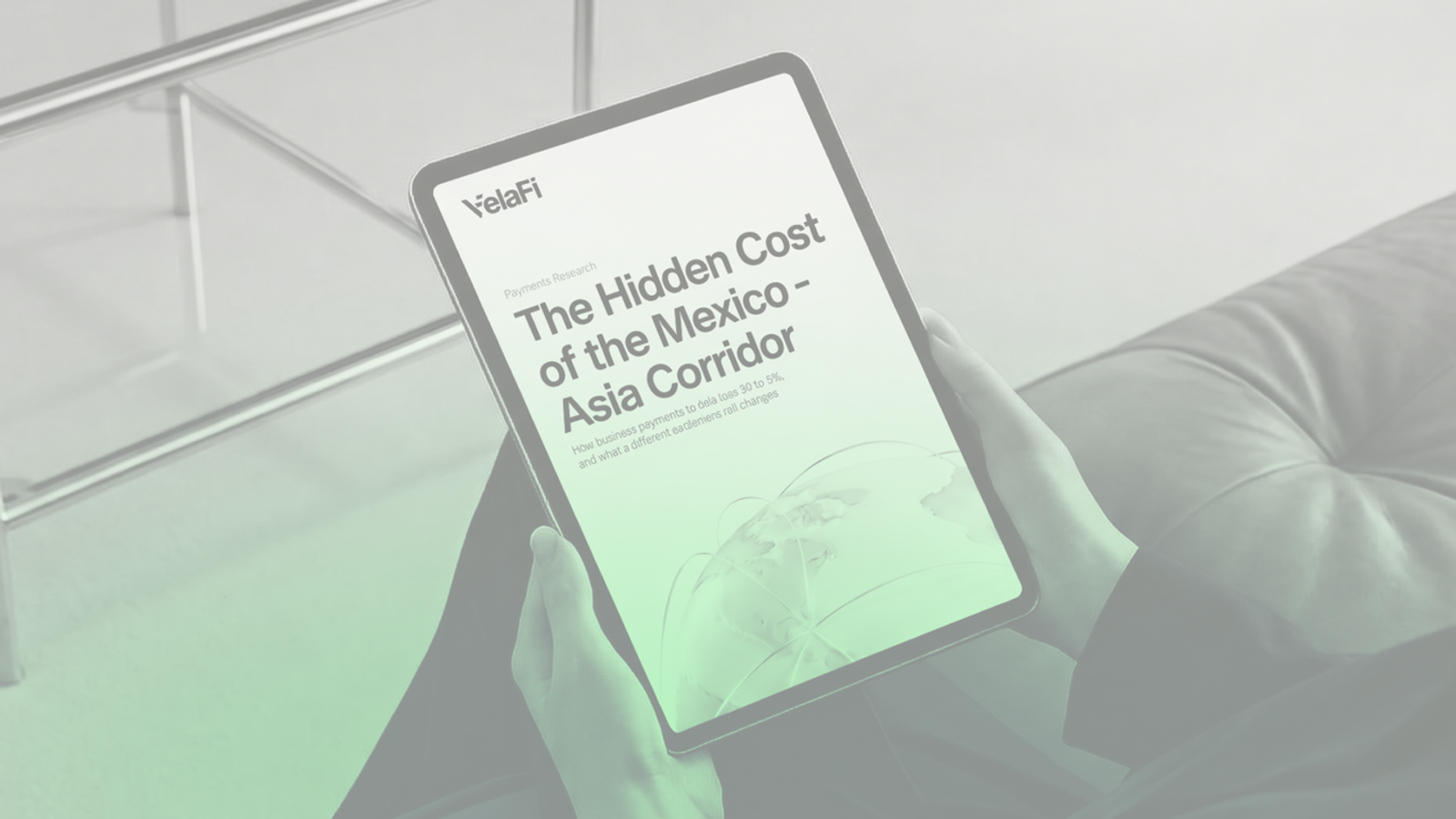
Today VelaFi releases The Hidden Cost of the Mexico–Asia Corridor, an industry research report examining why selected business-payment scenarios from Mexico to Asian suppliers may carry an estimated all-in cost of 3% to 5%, why those costs remain difficult to see, and how alternative settlement infrastructure changes the trade-offs.
The report’s central argument is that the visible transfer fee may represent only one part of the cost. FX spreads, intermediary deductions, multi-currency routing, settlement delays, and reconciliation work can materially change the economics of a payment.
Research note: Trade figures are drawn from external sources. The 3%–5% range is a VelaFi report estimate based on the scenarios and assumptions disclosed in the full methodology.
Download the report →
Key takeaways
- The corridor is economically significant. Preliminary Banco de México data shows that Asia supplied approximately $298.7 billion, or 45%, of Mexico’s merchandise imports in 2025—more than North America.
- The visible wire fee may be only one part of the cost. VelaFi’s report estimates that selected Mexico–Asia payment scenarios may carry an all-in cost of approximately 3% to 5%, depending on currencies, routing, transaction size, FX pricing, and fees.
- Payment architecture changes the trade-offs. The full report examines where costs accumulate, why they remain difficult to compare, and how traditional and tokenized settlement models differ.
Why this corridor matters now
Preliminary Banco de México data shows that Asia supplied approximately $298.7 billion—close to half—of Mexico’s merchandise imports in 2025. That scale creates substantial, recurring demand for outbound supplier payments and makes even small differences in cost, timing, and transparency commercially important.
Where the cost hides
The fee shown on a bank statement may not capture the full economics of a cross-border payment. FX spreads, intermediary deductions, multi-currency routing, funds-in-transit time, and reconciliation work can all affect the final cost. The report models these layers and explains the assumptions behind its estimated range.
Why these costs remain hard to see
The report identifies three structural forces: fewer correspondent-banking relationships, payment routes that may pass through an intermediate currency, and limited visibility into the all-in delivered cost. Together, these conditions can make it difficult for finance teams to compare providers or isolate where value is lost.
What a different rail changes
The report also evaluates an alternative model that combines stablecoin-enabled settlement with regulated on- and off-ramps and local payment infrastructure. Rather than presenting a universal answer, it compares the cost, speed, transparency, accessibility, and operational trade-offs finance teams should examine for their own corridors.
What's inside
The full report includes the complete cost model and methodology, a traditional-versus-tokenized rail comparison, an assessment against the G20’s four 2027 payment targets, and five questions finance teams should ask before changing providers.
A word from VelaFi
"Everyone assumes this corridor will be won on technology: speed, APIs, blockchain rails. It won't. It'll be won by whoever understands both sides well enough to make compliance and local knowledge invisible to the customer." — Maggie Wu, CEO & Co-Founder, VelaFi
Read the full report
Get the complete cost model, methodology, rail comparison, and finance-team decision framework. Download The Hidden Cost of the Mexico–Asia Corridor →
About VelaFi
VelaFi is a stablecoin-powered financial infrastructure platform for global businesses, operating through regulated entities across Latin America, Asia and other key markets. The platform connects local banking rails, global transfers, and major stablecoin networks to enable fast, compliant, and cost-efficient global money movement. VelaFi provides on/off ramps, pay-ins and pay-outs, cross-border payments, multi-currency accounts, FX services, liquidity and treasury tools, and secure custody, available directly on the platform or through API integrations.
Learn more at velafi.com.
Sources
- The Hidden Cost of the Mexico–Asia Corridor, VelaFi, 2026 — report landing page. Report-derived estimates include the 3%–5% all-in cost range, 2%–4% combined FX-spread range, and 45%–90% potential cost-reduction range; see the report methodology and limitations.
- “Total imports by country,” Banco de México / SAT / Secretaría de Economía / INEGI, 2025 data, preliminary and subject to revision — direct data table.
- Annual Progress Report on Meeting the Targets for Cross-border Payments: 2024 Report on Key Performance Indicators, Financial Stability Board, 21 October 2024 — report page.
- Modernizing Cross-Border Payments: New Mastercard Study Reveals the Path to Strengthening SMEs’ Success in Latin America and the Caribbean, Mastercard / PCMI / K2, July 2025 — source.
- “Correspondent banking relationships and the impact of de-risking,” BIS Quarterly Review, March 2020 — source.