USDT vs USDC vs EURC vs MXNB vs BRL1 vs COPM: Which Stablecoin Should Your Business Use?

Which stablecoin your business should use depends mostly on where the recipient is. Use MXNB for Mexico, BRL1 for Brazil, and COPM for Colombia to settle directly in local currency with no extra FX step; use USDC when audit and compliance matter, EURC for euro-native senders, and USDT for deep cross-corridor liquidity and everything else. Matching the coin to the corridor can cut 0.5%–1.5% off each transaction.
Key Takeaways
- Stablecoins are not interchangeable. The wrong one for a corridor adds FX fees, slow off-ramps, or compliance friction.
- Local-currency stablecoins (MXNB, BRL1, COPM) settle straight into SPEI, PIX, and Transfiya, so the recipient never touches crypto or a second conversion.
- USDC leads on compliance (monthly Deloitte attestations); USDT leads on liquidity.
- The single highest-impact rule: use a local-currency stablecoin when paying into Mexico, Brazil, or Colombia, and USDT or USDC for everything else.
Why the Choice Matters More Than You Think
Most businesses assume all stablecoins are interchangeable. They're not. Using the wrong stablecoin for a given corridor can mean:
- Unnecessary FX conversion fees — e.g., paying a Mexico supplier in USDC when MXNB settles directly in MXN
- Slower off-ramps — some stablecoins don't have mature local banking rails in LatAm
- Compliance mismatches — certain stablecoins face regulatory restrictions depending on the jurisdiction
- Liquidity slippage — smaller-cap stablecoins can lose value on large conversions
The right stablecoin isn't just a technical choice. It's a cost and efficiency decision.
VelaFi's Six Stablecoins: Full Comparison
Breaking Down Each Stablecoin
USDT — The Global Liquidity Layer
Best for: High-volume payments in markets where USDT is the dominant settlement currency; bridging liquidity across corridors.
Why businesses use it: USDT has the deepest liquidity of any stablecoin — virtually every exchange, OTC desk, and payment provider globally supports it. For corridors where no local stablecoin exists, USDT is the most efficient USD proxy.
Watch out for: Reserve transparency is less rigorous than USDC. Regulatory restrictions in some EU-compliant contexts. Not ideal, when a local-currency stablecoin (MXNB, BRL1, COPM) is available — you'll pay an extra FX step.
USDC — The Compliance Gold Standard
Best for: US-to-LatAm flows, large B2B invoices, businesses with strict audit requirements, and any scenario where counterparties require a fully regulated USD stablecoin.
Why businesses use it: Circle is a US-licensed money transmitter. USDC undergoes monthly third-party attestations by Deloitte, with reserves in US Treasuries and cash. For CFOs and finance teams, USDC is the easiest stablecoin to defend in an audit.
Watch out for: Slightly lower liquidity than USDT in some LatAm OTC markets. A brief depeg event occurred in March 2023 (resolved within 48 hours) due to SVB exposure — reserves have since been restructured.
EURC — The Euro Bridge
Best for: European businesses paying LatAm suppliers or employees; businesses billing clients in EUR and settling operations in LatAm; EUR-denominated B2B contracts.
Why businesses use it: EURC (Circle's euro stablecoin) eliminates the USD intermediary step for EUR-native businesses. Instead of EUR → USD → MXN, flows can go EUR → EURC → local fiat — fewer conversion steps, less FX loss.
Watch out for: Smaller market cap and liquidity compared to USDT/USDC. Best used for defined bilateral corridors rather than open-market settlement.
MXNB — The Mexico Corridor Specialist
Best for: Any payment flowing into or out of Mexico; paying Mexican suppliers, employees, or contractors directly in pesos.
Why it's a game-changer: MXNB is pegged to the Mexican Peso and integrates directly with SPEI — Mexico's domestic instant payment rail. This means recipients receive MXN in their bank account, with no crypto exposure and no FX conversion needed on their end. What used to take 2–3 days via SWIFT now settles in minutes.
Watch out for: Liquidity is naturally more limited than USD-pegged stablecoins. Best deployed within VelaFi's platform where liquidity is managed end-to-end.
BRL1 — The Brazil Corridor Specialist
Best for: Brazil-bound payments; paying Brazilian suppliers, employees, or marketplace sellers directly in reais.
Why it's a game-changer: BRL1 is pegged to the Brazilian Real and connects to PIX — Brazil's central bank instant payment system, one of the most adopted real-time payment rails in the world with 178M+ registered users. Settlement is near-instant, and recipients need zero crypto knowledge.
Watch out for: Brazil has unique FX and tax regulations (IOF tax on international transfers). VelaFi's compliance framework handles this, but it's important to work with a platform that understands Brazilian regulatory specifics.
COPM — The Colombia Corridor Specialist
Best for: Colombia-bound payments; paying Colombian partners, employees, or suppliers in pesos.
Why it matters: Colombia is one of Latin America's fastest-growing economies and a major destination for outsourcing and digital services. COPM integrates with Transfiya(Colombia's electronic payment system), enabling direct COP bank deposits without conversion friction.
Watch out for: As the newest stablecoin in VelaFi's portfolio, COPM has the smallest liquidity pool of the six. Most suitable for planned, scheduled payments rather than high-frequency spot transactions.
Decision Framework: Which Stablecoin for Which Scenario?
Decision framework: Mexico recipient → MXNB. Brazil recipient → BRL1. Colombia recipient → COPM. EUR-native sender → EURC. Audit/compliance priority → USDC. Everything else → USDT.
The Core Rule
Use local-currency stablecoins (MXNB, BRL1, COPM) whenever the recipient is in Mexico, Brazil, or Colombia. Use USDT or USDC for everything else.
This single decision can reduce your cross-border payment cost by 0.5%–1.5% per transaction by eliminating redundant FX conversion steps.
Four Pitfalls to Avoid
❌ Pitfall 1: Defaulting to USDT for EverythingUSDT is the most liquid stablecoin globally — but if you're paying a supplier in Mexico, routing through USDT means your recipient still has to convert USDT → MXN. MXNB eliminates that step entirely.
❌ Pitfall 2: Ignoring Chain SelectionSending USDC on Ethereum mainnet during peak hours can cost $10–$20 per transaction. The same transfer on Solana or Base costs under $0.01. VelaFi optimizes chain routing automatically, but if you're managing transfers manually, chain selection matters.
❌ Pitfall 3: Skipping the Off-Ramp ValidationNot all platforms that support a stablecoin also have the local banking rail to off-ramp it. A platform supporting BRL1 on paper means nothing if they don't have an active PIX integration. VelaFi's corridors are fully integrated end-to-end.
❌ Pitfall 4: Treating All USD Stablecoins the Same for ComplianceUSDT and USDC are both USD-pegged, but their compliance profiles are completely different. For transactions that will be audited, USDC's monthly Deloitte attestations make it far easier to justify to a finance team or external auditor.
FAQ
Can I hold multiple stablecoins in my VelaFi account simultaneously?
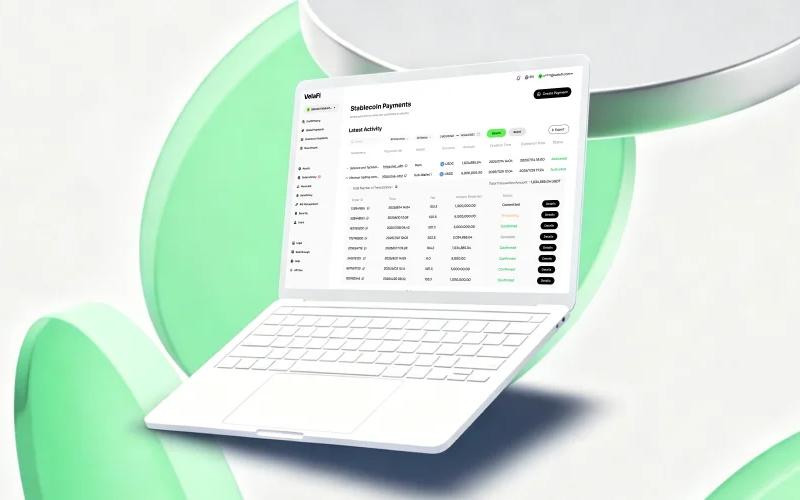
Yes. VelaFi's platform supports multi-stablecoin treasury management — you can hold, convert, and transfer across all six stablecoins from a single account.
How does VelaFi handle the MXNB/BRL1/COPM off-ramp to local banks?
VelaFi is directly integrated with SPEI (Mexico), PIX (Brazil), and PSE (Colombia). Once your recipient's bank details are registered, off-ramp to local fiat is fully automated.
What's the minimum transfer size?
VelaFi is optimized for enterprise volumes, but there is no enforced minimum. For very small amounts, the per-transaction fixed costs may reduce efficiency.
Is EURC available for LATAM off-ramp?
EURC is primarily used for EUR on-ramp (converting euros into the VelaFi ecosystem). From there, it can be converted to any of the other supported stablecoins for LatAm settlement.
How do I get started with VelaFi?
Visit velafi.com and submit a business inquiry. The team will guide you through KYB onboarding and corridor setup — typically within 1 business day.
Sources
- The Block, JPMorgan on Circle USDC stablecoin growth (2024)
- Klever, USDC vs USDT — All About the Biggest Stablecoins
- EZ Smartbox, USDC vs USDT: Choosing the Best Stablecoin
- Bleap, USDT vs USDC (2024)