How to Send Vendor Payments Securely in 2026 [A Guide]

Vendor payments can fail for different reasons. A fraudster may impersonate a vendor and send new bank details, an attacker may gain access to a company's payment account, or an employee may accidentally release a duplicate transfer. Each situation calls for a different security measure.
Business email compromise is a particular concern. According to the 2026 Nasdaq Verafin Global Financial Crime Report, estimated losses from business email compromise in Latin America grew at a 12% compound annual rate over the two years through 2025. However, verifying an email request and protecting access to a payment account are separate tasks.
The most secure approach to vendor payments is to apply the right controls before, during, and after each transaction. This article explains the main risks, the controls that address them, and how different payment methods affect processing, monitoring, and recovery options.
Key Takeaways
- Different risks require different controls: Independent vendor verification helps address fraudulent instructions, while authentication, access restrictions, and approval workflows reduce unauthorized access and payment risks.
- Pre-release checks are especially important: Verify beneficiary changes, review unusual transactions, and validate payment details before sending funds. Post-payment monitoring and reconciliation can help detect discrepancies, but they cannot undo a completed fraudulent transfer.
- Payment methods influence controls and recovery options: Bank transfers, instant payment rails, and virtual cards have different features and limitations. No method independently guarantees that the intended vendor receives the payment.
- VelaFi supports visibility into eligible cross-border vendor payments: For supported LATAM–Asia flows, VelaFi provides local payment connectivity, FX services, payment-status tracking, transaction records, and platform or API access. Businesses should confirm which security controls are available for their specific setup.
What Risks Affect Vendor Payments?
A secure vendor payment workflow should establish who is being paid, control who can initiate and approve transactions, validate payment details, and provide a way to respond when something goes wrong. Different problems occur at different stages, so the controls should match the risk.
| Risk | How It Can Affect a Vendor Payment | Most Relevant Controls |
|---|---|---|
| Fraudulent payment instructions | An impersonator or compromised vendor email account supplies bank details controlled by a fraudster | Independent verification through a previously established vendor contact and approval of beneficiary changes |
| Compromised payment access | Stolen credentials or exposed API keys allow an attacker to access payment functions | Multifactor authentication, restricted permissions, credential protection, and access monitoring |
| Unauthorized or improperly approved payments | A transaction bypasses the required review or is released by someone without appropriate authority | Separation of duties, approval workflows, transaction limits, and restricted release permissions |
| Incorrect or duplicate payments | A payment contains the wrong account, amount, or currency, or an invoice is paid more than once | Pre-release validation, invoice matching, duplicate checks, and post-payment reconciliation |
These controls do different jobs. For example, multifactor authentication can help prevent unauthorized account access, but it cannot confirm that an apparently legitimate vendor email contains genuine payment instructions. Conversely, calling a vendor to verify new bank details does not protect the company's payment account from stolen credentials.
Recovery procedures belong to the response stage, not the prevention stage. A bank recall request, card dispute, or instant-payment fraud-return process may provide a route to investigate or recover funds, but none guarantees recovery.
How to Apply Security Controls to Vendor Payments
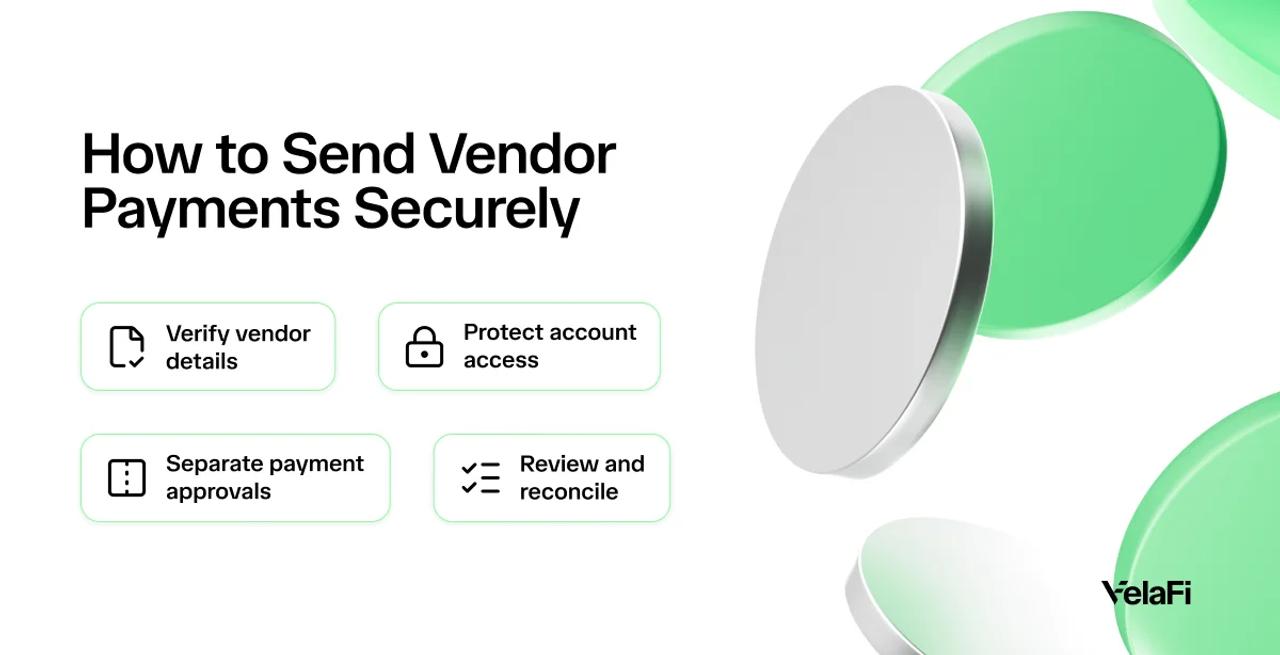
A secure payment workflow addresses risks before a transfer is released and preserves information needed to investigate exceptions afterward.
1. Verify New or Changed Beneficiary Details
Confirm new or updated payment instructions through a previously verified vendor contact. Do not rely on a telephone number, email address, or website supplied in the change request itself.
Check the vendor's legal name, beneficiary account details, receiving institution, and payment currency. Record who completed the verification, when it took place, and which details were confirmed. Independent verification helps address fraudulent changes to payment instructions, including those sent from compromised vendor email accounts.
2. Restrict Access to Payment Accounts and APIs
Give users and connected systems only the permissions needed for their responsibilities. Apply multifactor authentication where supported, protect API credentials, remove access that is no longer required, and review unusual sign-ins or activity.
Access controls address unauthorized use of payment systems. They do not replace independent verification of the vendor or its instructions, because a person with legitimate access can still be deceived into making a fraudulent payment.
3. Separate Beneficiary Changes From Payment Approval
Where possible, employees who create or change beneficiary records should not independently approve and release payments to those accounts. Apply two-person approval to changes and transactions that meet the company's risk criteria.
Consider additional review for first-time payments, unusually large transfers, or requests that bypass the usual approval process. These checks help catch unauthorized or suspicious transactions before release, although an approval alone does not prove that the beneficiary details are genuine.
4. Review Exceptions and Reconcile Completed Payments
Flag unusual amounts, unexpected currency changes, newly added recipients, duplicate invoice references, and requests for urgent exceptions. Investigate flagged transactions before release when monitoring and payment workflows allow it.
After processing, reconcile completed payments against approved invoices, payment references, beneficiary information, and accounting records. Reconciliation can identify mistakes or suspicious discrepancies, but it may only detect a fraudulent transaction after funds have left the business.
If fraud is suspected, contact the payment provider or sending bank immediately and follow the relevant reporting and escalation procedures. Recovery depends on the payment method, transaction status, and applicable rules.
How Payment Methods Affect Security and Recovery
Payment methods differ in the transaction controls they offer and the options available when a payment goes wrong.
The categories below operate at different levels. Local real-time systems such as Pix and SPEI are forms of account-to-account transfers, while a B2B payment platform can provide an interface for several underlying payment methods.
Bank Transfers
Bank transfers can support recurring supplier payments using saved beneficiary details and transaction references. Depending on the institution and service, they may also offer payment approval settings, account-detail checks, and tracking.
Fraudulent beneficiary details can still result in an authorized transfer to the wrong account. If fraud is discovered after release, the sending institution may initiate a recall or recovery request, but success is not guaranteed.
Local Real-Time Payment Rails
Local real-time rails allow funds to move quickly between participating accounts. Relevant examples in Latin America include Mexico's SPEI, Brazil's Pix, and Colombia's Bre-B.
Because instant transfers may be completed before suspicious instructions can be investigated, verification and approval before release are particularly important.
Certain rails have specific fraud-response mechanisms. For example, Brazil's Pix offers the Special Return Mechanism (MED) for eligible fraud and operational-failure situations. It does not apply to every payment mistake or commercial dispute, and a return is not guaranteed.
For cross-border vendor payments, domestic real-time rails may serve the pay-in or payout stage rather than the full international route.
Virtual Cards
Virtual commercial cards can offer transaction-specific restrictions, depending on the issuer and program. Available features may include spending limits, merchant-category restrictions, expiration settings, or single-use credentials.
These controls can limit how card credentials are used but cannot prevent an authorized user from approving a fraudulent purchase. Some transactions may qualify for issuer disputes, although eligibility and outcomes depend on the card program and circumstances.
Virtual cards are also unsuitable for vendors that do not accept commercial card payments.
B2B Payment Platforms
A B2B payment platform is generally a payment-management layer rather than a separate settlement rail. Depending on the provider, it may connect users to bank transfers, local payment systems, FX services, and other supported options.
Some platforms provide role-based permissions, beneficiary management, approval workflows, monitoring, and centralized transaction records. Available protections vary by provider, while recovery procedures remain subject to the underlying payment method.
Vendor Payment Methods: Security Considerations Compared
The relevant comparison is not which method is universally safest, but which controls are available and what limitations remain for a specific payment.
| Payment Option | Relevant Security Features | What It Doesn't Solve | After Sending |
|---|---|---|---|
| Bank transfers | Provider-specific authorization controls, beneficiary management, and payment tracking | Fraudulent instructions can still result in an authorized transfer to the wrong account | Recall requests may be possible, but recovery isn't guaranteed |
| Local real-time rails | Rail- and institution-specific safeguards | Fast processing limits the opportunity to intervene after release, making pre-release checks important | Certain rails provide fraud-return procedures, but recovery may be limited |
| Virtual cards | Spending limits, merchant restrictions, and credential controls, depending on the program | Card restrictions don't independently verify the vendor or the legitimacy of a purchase | Eligible transactions may qualify for issuer disputes |
| B2B payment platforms | May provide permissions, approval workflows, monitoring, and centralized records | Available protections depend on the provider and don't automatically validate payment instructions | Recovery depends on the underlying rail and provider |
A sound decision starts with the vendor's accepted payment methods, the transaction's risks, and the controls the business and its provider can actually enforce.
Additional Checks for Cross-Border Vendor Payments
Cross-border vendor payments may involve several institutions and jurisdictions.
The main security questions remain the same: is the recipient genuine, is the instruction authorized, and can the business investigate or escalate a suspicious transfer? Additional data and compliance requirements matter, but should not be confused with fraud-prevention controls.
1. Verify the Intended Recipient Across Markets
Beneficiary names, account identifiers, receiving-bank information, and supporting documents may differ by market. Confirm the required details with the provider and, where instructions are new or changed, independently with the vendor.
Correct formatting can help avoid rejected payments. It does not establish that a payment request is genuine. If a vendor asks to use an unfamiliar third-party account or payment agent, verify the relationship and authorization before release.
2. Clarify Who Handles Each Payment Stage
A cross-border provider may use different banks or regulated partners for collection, conversion, and final payout. Identify the institution responsible at each stage and the applicable contact point for reporting suspected fraud or requesting a recall.
Payment-status information can help distinguish a transaction initiated by the payer from funds finally credited to the vendor. Tracking is useful for investigation and reconciliation, but visibility alone cannot prevent fraudulent instructions or guarantee recovery.
What to Look for in a Secure Vendor Payment Provider
Payment providers differ in the security controls they offer and the responsibilities they retain or assign to partners. Businesses should evaluate which protections are available for their intended service and which controls must be managed internally.
1. Confirm Available Account and Payment Controls
Ask which protections are offered for your specific product and corridor: multifactor authentication, user permissions, dual approval, beneficiary-change reviews, transaction limits, API access controls, monitoring, and audit records. Check whether the controls are built into the provider's service or must be configured within your own finance systems.
A provider may offer tracking without pre-release approvals, or user access controls without independent beneficiary verification. Confirm the distinction before relying on a feature to address a particular risk.
2. Read Security Evidence by Scope
SOC 2 and ISO/IEC 27001 provide the following forms of independent security evidence:
| Security Evidence | What It Covers | What to Check |
|---|---|---|
| SOC 2 report | Controls relevant to areas such as security, availability, processing integrity, confidentiality, or privacy | Which entity, systems, services, and reporting period are covered |
| ISO/IEC 27001 certification | An information security management system assessed against ISO/IEC 27001 requirements | Which organization and ISMS scope are included in the certification |
SOC 2 Type I reports assess the suitability of control design at a specific point in time.
SOC 2 Type II reports also evaluate whether those controls operated effectively over a defined period. When reviewing a provider's security evidence, businesses should check the report type, covered systems, and examination period.
Neither establishes that a provider is authorized to offer a particular payment service. Evaluate security assurance and regulatory permission separately.
3. Confirm Legal and Regulatory Responsibilities
Identify the legal entity responsible for providing the payment service and confirm that its licenses, registrations, or authorizations cover the intended activity and market. A provider may operate through different legal entities or regulated partners depending on the jurisdiction.
Regulatory authorization and payment security controls address different requirements. A provider's legal permission to offer a service does not independently verify vendor instructions or prevent unauthorized payments.
4. Check Incident and Continuity Procedures
Review how suspected fraud, technical incidents, failed transfers, and outages are escalated. Confirm support channels, applicable service levels, the roles of partner institutions, and the procedure for investigating pending payments.
Ask who should be contacted immediately when fraud is suspected. Recovery windows and available procedures depend on the payment method and status, so escalation arrangements should be clear before a problem occurs.
How VelaFi Supports Cross-Border Vendor Payments
VelaFi provides B2B cross-border payment infrastructure for businesses operating across Latin America and Asia. Its platform connects supported local payment methods, currency conversion, and international payouts, with access to transaction information through its platform or APIs.
VelaFi holds ISO/IEC 27001 certification and has completed an independent SOC 2 Type II audit covering its internal security controls. As described in our SOC 2 announcement, the audit covered access management, monitoring systems, and incident response procedures.
For supported vendor payment flows, VelaFi provides several relevant capabilities:
- Local pay-ins and payouts: Businesses can access local payment methods across supported Latin American markets to fund cross-border payments and deliver funds to vendors in the agreed currency.
- Currency conversion: FX services allow businesses to manage supported currency conversions within their cross-border payment operations.
- Payment tracking and records: VelaFi's Global Payment feature tracks orders through Pay-in, Pay-out, and Funds Received stages. Finance teams can monitor payment progress and download completed transaction receipts for reconciliation.
- Platform and API access: Businesses can manage supported payment flows through VelaFi's platform or APIs, allowing payment information to be integrated into their existing finance processes.
Payment tracking and transaction records support visibility and reconciliation, but they do not independently verify beneficiary details or prevent unauthorized transfers. Businesses should apply their own verification and approval controls and confirm which additional protections the provider supports.
Before onboarding, businesses should confirm the responsible legal entity, available payout routes, supported currencies, and applicable security documentation for their intended corridor.
Contact VelaFi to discuss the payment methods and integration options available for your cross-border vendor payments.
FAQ
1. Can a vendor payment be recalled after it has been sent?
Sometimes. Contact the sending bank or provider immediately if a payment may be fraudulent. A recall request may be possible for some transfers, eligible card payments may qualify for a dispute, and some instant-payment systems offer specific fraud-return procedures. None guarantees recovery, and the available response depends on the method and transaction status.
2. What should I do if the beneficiary name does not match the vendor name?
Pause the payment and investigate the difference. A legitimate vendor may use a trading name or an authorized payment agent, but the relationship and account details should be confirmed through a previously established vendor contact before release. Do not rely on contact information supplied only in the suspicious request.
3. Does multifactor authentication prevent vendor payment fraud?
Multifactor authentication helps protect accounts from unauthorized access, including some attacks involving stolen passwords. It cannot verify that a changed bank account belongs to a genuine supplier or prevent an authorized employee from acting on fraudulent instructions. Independent beneficiary verification and payment approval controls remain necessary.
4. How do I secure vendor payments sent through an API?
Restrict API access to authorized systems, protect and rotate credentials as appropriate, and apply the permissions and transaction controls supported by the provider. Where signed webhooks are available, verify signatures before trusting status notifications, and use authenticated API requests when additional confirmation is needed. These technical safeguards do not replace beneficiary and payment-instruction checks.
5. Do I need to reverify vendor bank details for recurring payments?
Reverify details whenever instructions change or a request appears suspicious. For unchanged details, use a periodic or risk-based review process based on factors such as payment size, time since the previous payment, and vendor activity. Reused account details are convenient, but should not be treated as permanently verified.
Editorial disclosure: This guide is published by VelaFi. The educational sections describe common industry models, while VelaFi-specific capabilities are based on the company's current product and regulatory information. Availability, regulated entities, payment rails, pricing, and processing times vary by product and corridor.
Sources:
- 2026 Global Financial Crime Report, Nasdaq Verafin, 2026
- G20 Roadmap for Cross-border Payments: Consolidated Progress Report for 2025, Financial Stability Board, 2025
- SOC 2® Reporting on an Examination of Controls at a Service Organization Relevant to Security, Availability, Processing Integrity, Confidentiality, or Privacy, AICPA & CIMA, 2022
- ISO/IEC 27001:2022: Information Security, Cybersecurity and Privacy Protection, ISO, 2022