Stablecon Roadshow: Why the Asia–LATAM Corridor Matters

Global trade is increasingly being shaped by risk rather than ideology. Tariffs, geopolitics, and regulatory pressure are pushing companies to redesign supply chains for resilience rather than pure cost efficiency. One corridor where this shift is becoming particularly visible is the Asia–Latin America route, where trade flows are expanding across more jurisdictions, counterparties, and currencies than ever before.
Key Takeaways
- VelaFi and Rain powered the first Stablecon Roadshow in Latin America, held in Mexico City.
- Trade between China and Latin America reached a record $518 billion in 2024, and nearshoring is reshaping how companies build supply chains.
- Cross-border B2B payments have not kept pace: settlement is slow, reconciliation is fragmented and working capital gets stuck in transit.
- Maggie Wu described stablecoins as a digital liquidity layer that works alongside regulated banks, not a replacement for them.
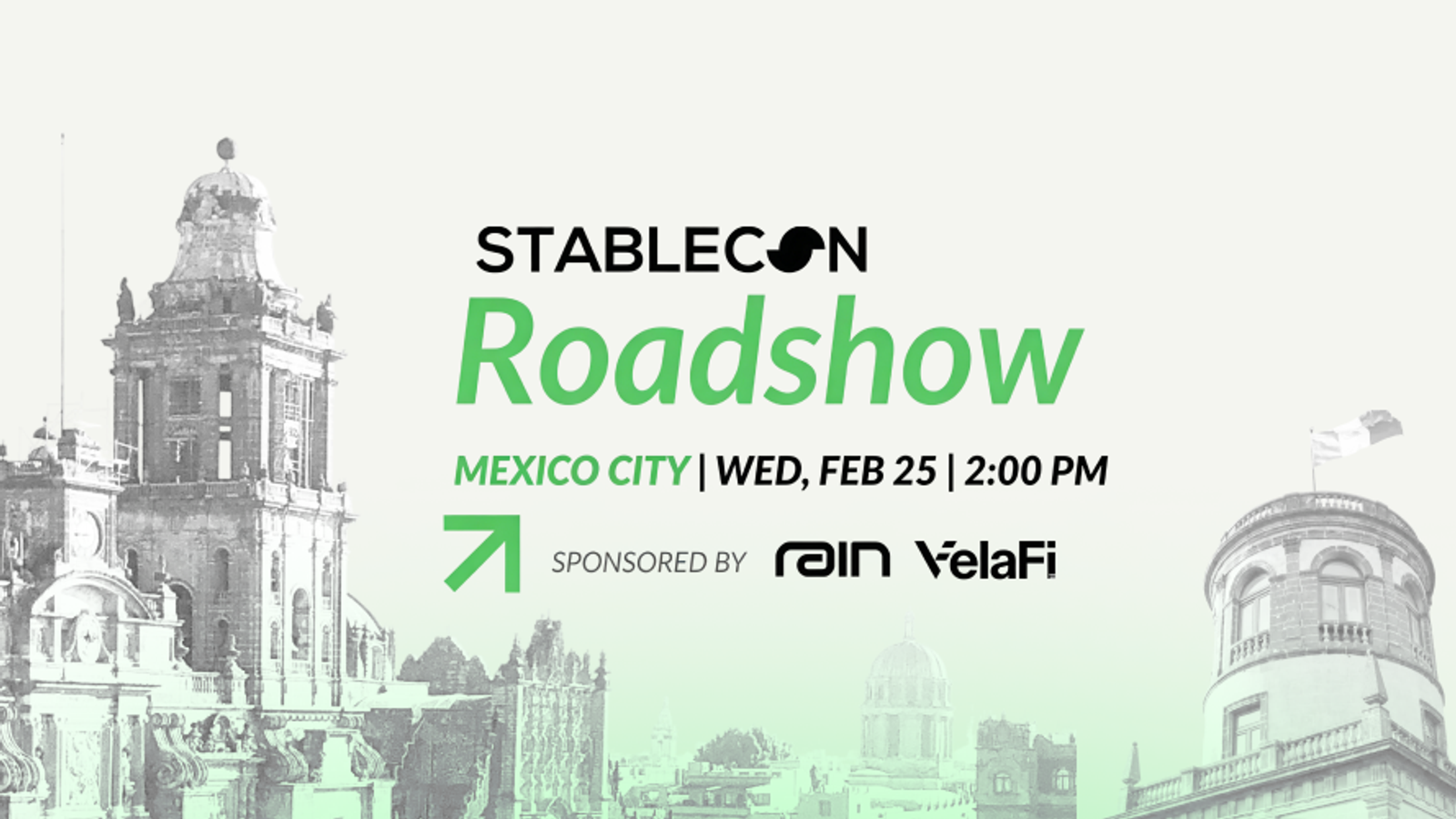
This evolving reality framed the first Stablecon Roadshow in Latin America, powered by VelaFi and Rain, held in Mexico City.
Operators, investors, and infrastructure builders gathered to discuss how cross-border payments must evolve to match the pace of modern trade.
During a fireside chat with Nik Milanovic, CEO of Stablecon, Maggie Wu, CEO and Co-Founder of VelaFi, shared why the Asia–LATAM corridor is becoming one of the most consequential trade routes in the global economy, and why financial infrastructure is still catching up.
The Scale of the Asia–LATAM Corridor
The scale of the corridor explains why the discussion matters. According to the United Nations Economic Commission for Latin America and the Caribbean (ECLAC), trade between the United States and Latin America now exceeds $1 trillion annually, while China's Ministry of Commerce reports that trade between China and Latin America reached a record $518 billion in 2024. These flows reflect deeper integration between Asian manufacturing ecosystems and Latin American markets.
At the same time, supply chains themselves are undergoing structural change. As Maggie noted during the discussion, nearshoring and friendshoring are no longer temporary responses to geopolitical tensions. They represent a deeper redesign of how companies structure global trade.
“Nearshoring is no longer a headline. It’s a structural redesign of supply chains,” she explained.
Why Payments Have Not Kept Up With Trade
Yet financial infrastructure has not evolved at the same pace as global trade.
Cross-border B2B payments remain slow, opaque, and operationally intensive. Mastercard says banks report that 15 to 20 percent of cross-border payments are interrupted by exceptions, such as mistyped routing instructions or incomplete information, so many transactions still require manual intervention somewhere along the payment chain.
For companies managing global supply chains, this creates operational friction: delayed settlements, fragmented reconciliation processes, and working capital trapped in transit.
Maggie illustrated this challenge with two practical examples:
- The first is cross-border payroll. Multinational companies paying employees or contractors across Latin America often face settlement delays, unpredictable FX spreads, and recurring compliance friction through traditional banking channels.
- The second involves supplier payments across Asia–Latin America trade routes, where importers paying manufacturers in countries such as Hong Kong, Singapore or Vietnam must rely on correspondent banking chains involving multiple intermediary institutions. This can introduce delays, additional fees, and uncertainty around settlement timing.
Faster settlement can directly improve inventory turnover, strengthen supplier relationships, and significantly enhance capital efficiency across global supply chains.
In Latin America in particular, whether for manufacturers in Mexico, commodity exporters in Brazil, or logistics hubs in Chile and Colombia, treasury teams often need to manage multiple currencies, maintain relationships with several banks, and navigate complex regulatory environments.
As a result, more companies are moving away from treasury models that rely solely on traditional cross-border settlement networks. Instead, they are adopting hybrid liquidity strategies that hold U.S. dollars, local currencies, and increasingly stablecoins, enabling faster settlement while reducing unnecessary foreign-exchange conversion costs.
Why Stablecoins Are Gaining Traction
These challenges help explain why stablecoin-based payment infrastructure is gaining traction in cross-border commerce.
The scale of the opportunity is substantial. According to analysis from FXC Intelligence, stablecoin infrastructure could address more than $16 trillion in cross-border payments in a base scenario, with potential to expand significantly as adoption grows across global trade corridors.
Industry research estimates stablecoin transfer volume reached approximately $27.6 trillion in 2024, surpassing the combined transaction volumes of global card networks such as Visa and Mastercard. Latin America has also become one of the fastest-growing regions for stablecoin adoption, driven by cross-border commerce, dollar demand, and the need for faster settlement infrastructure.
Rather than replacing traditional financial institutions, Maggie described stablecoins as a digital liquidity layer that complements existing financial systems by enabling faster settlement while still relying on regulated banking infrastructure for custody, compliance, and fiat conversion.
For businesses operating along the Asia–LATAM corridor, including logistics providers, importers, exporters, and cross-border commerce platforms, the benefits are increasingly clear: faster settlement, improved transparency, and reduced dependence on complex correspondent banking networks.
What Comes Next for Stablecoins
Looking ahead, Maggie suggested that the conversation around stablecoins is entering a new phase. "Stablecoins are moving from a crypto narrative to an enterprise infrastructure narrative," Maggie said. "In the near future, we expect them to become increasingly embedded in everyday financial activity."
The discussion at Stablecon Roadshow ultimately highlighted a broader reality: the trade corridor already exists. The financial infrastructure needed to support it at scale is only now beginning to emerge.
Sources & References
ECLAC – United States–Latin America Trade Developments: https://www.cepal.org/en/publications/68681-united-states-latin-america-and-caribbean-trade-developments-2023State Council China - Trade booms, investment accelerates as China, Latin America deepen ties: https://english.www.gov.cn/news/202505/23/content_WS68306217c6d0868f4e8f2c7b.htmlReuters – China–Latin America Trade Data: https://www.reuters.com/world/china/china-latin-america-trade-record-2024Kearney – Nearshoring in Mexico Report: https://www.kearney.com/service/strategic-operations/article/-/insights/nearshoring-in-mexicoFXC Intelligence – Cross-Border Payments Market Data: https://www.fxcintel.com/research/press-releases/new-data-cross-border-payments-market-now-worth-over-194tn-and-is-forecast-to-reach-320tn-by-2032Modern Treasury – Stablecoins in B2B Payments: https://www.moderntreasury.com/journal/stablecoins-in-action-b2b-and-b2c-paymentsArtemis Analytics – Stablecoin Market Data: https://www.artemis.xyz/research/stablecoin-volumeFXC Intelligence - The state of stablecoins in cross-border payments: The 2025 industry primer: https://www.fxcintel.com/research/reports/ct-state-of-stablecoins-cross-border-payments-2025
Frequently Asked Questions (FAQs)
1. What was the Stablecon Roadshow in Mexico City?
It was the first Stablecon Roadshow in Latin America, powered by VelaFi and Rain. Operators, investors and infrastructure builders met to discuss how cross-border payments need to change to keep up with trade. VelaFi CEO Maggie Wu spoke in a fireside chat with Stablecon CEO Nik Milanovic.
2. Why does the Asia–LATAM payment corridor matter?
Trade between Asia and Latin America keeps growing, with China–Latin America trade alone reaching $518 billion in 2024. That makes it one of the main drivers of cross-border payment in Latin America, yet the payment rails behind it are still slow and costly.
3. Why are B2B payments between Asia and Latin America slow?
Many b2b cross border payments still pass through correspondent banking chains with several intermediary banks. Each step can add delays, fees and uncertainty about when the money will arrive.
4. What payment problems did Maggie Wu highlight?
Two examples: cross-border payroll, where settlement delays, FX spreads and compliance work are among the most common cross border payroll challenges, and supplier payments, where importers need to pay overseas suppliers in places such as Hong Kong, Singapore or Vietnam through long banking chains.
5. How do stablecoins fit into the corridor?
Maggie described stablecoins as a digital liquidity layer. They speed up settlement, while regulated banks still handle custody, compliance and conversion to local currency.