Stablecoin Cross-Border Payments for Businesses

International business payments should be simpler than they are today.
For many companies, cross-border payments still move through systems built on layered banking relationships, limited operating windows, and fragmented settlement visibility.
A payment may leave one account quickly but still take days to fully settle, confirm, and reconcile. Traditional bank wires cost an average of 6.49% of the transfer amount and take 1–5 business days to settle (World Bank, Q1 2025).
For finance and operations teams, the problem is rarely just the transfer fee. It is the combination of delay, cost opacity, limited tracking, and manual follow-up that makes cross-border payments harder than they should be.
Key Takeaways
- Traditional cross-border payments are still too slow, too opaque, and too expensive for most businesses — average cost is 6.49% of the transfer amount, with 1–5 business day settlement times. (World Bank, Q1 2025)
- Stablecoin cross-border payments move value faster, with a more transparent cost structure and fewer intermediaries — typically settling in minutes at under 1% total cost.
- The real differentiator is not on-chain speed alone. It is whether a provider connects stablecoin settlement to local payout rails — SPEI in Mexico, PIX in Brazil, PSE/Bre-B in Colombia — so recipients receive local currency in their bank account.
- VelaFi supports six stablecoins (USDT, USDC, EURC, MXNB, BRL1, COPM) with direct local rail integration across LATAM, Asia, and the U.S. — built for enterprise B2B payment operations, not just on-chain transfers.
- Businesses should evaluate providers on corridor fit, local rail depth, compliance credentials, total cost visibility, and reconciliation output — not just headline transfer speed.
Why Traditional Cross-Border Payments Still Create Friction
Traditional international payments remain globally accepted, but they consistently create operational drag. The friction shows up in five forms:
1. Hidden total cost
The visible outbound fee is rarely the real cost. FX spreads (typically 1.5–3% above mid-market rate), correspondent bank deductions ($15–$50 per hop), and receiving-side fees mean the true cost of a $50,000 wire can exceed $800–$900. That number does not appear in any single line item.
2. Settlement delays
Traditional wires take 1–5 business days. SWIFT reported in 2024 that 90% of cross-border payments reach the destination bank within an hour, yet only 43% reach the end customer account within an hour. That gap — between bank receipt and usable funds — is where most operational risk lives.
3. Limited visibility
Finance teams frequently cannot answer: Where is the payment now? How much will the recipient actually receive? When will local funds become available? The World Bank notes that limited transparency in cross-border payments reduces users’ ability to compare speed, fees, and service quality across providers.
4. Fragmented local payout infrastructure
Latin America is not one payments market. Mexico, Brazil, and Colombia each run on different local rails — SPEI, PIX, PSE/Bre-B — with different compliance rules, settlement mechanics, and recipient expectations. A payment that settles on-chain does not automatically land in a local bank account.
5. Reconciliation burden
Cross-border payments are not complete when the money leaves. They are complete when finance teams can verify what moved, what arrived, what was deducted, and how the transaction should be recorded. Without standardized reconciliation outputs, this becomes a manual process that scales poorly.
What Stablecoin Cross-Border Payments Change
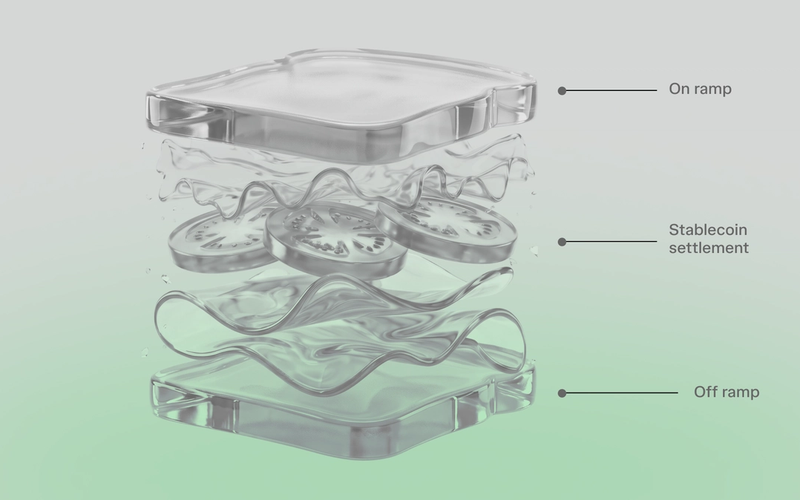
Stablecoin-enabled payment infrastructure gives businesses a different settlement model. Instead of relying entirely on correspondent banking chains and fixed operating windows, value moves through a more direct, always-on settlement path. That reduces delays, improves traceability, and makes the payment process easier to monitor from initiation through final payout.
Where Businesses Use This Model Today
The strongest use cases are the ones where timing, visibility, and payout flexibility matter most:
- Paying suppliers internationally — including businesses that pay suppliers in China, where USDT dominates corridor liquidity and recipients do not need to manage stablecoins directly.
- Cross-border payouts — recurring or high-volume disbursements to contractors, freelancers, and marketplace sellers across LATAM and Asia.
- LATAM settlement — connecting stablecoin-enabled settlement to SPEI (Mexico), PIX (Brazil), and PSE/Bre-B (Colombia) so recipients receive local currency in their bank account.
- Treasury operations — faster capital movement between entities improves liquidity and reduces the working capital trapped ‘in transit’.
- Cross-border payroll — using local-currency stablecoins (MXNB for Mexico, BRL1 for Brazil, COPM for Colombia) to settle payroll directly in local fiat without FX conversion friction.
Why VelaFi
VelaFi is built for business payments, not just on-chain transfers. The platform combines stablecoin-enabled settlement with direct local rail integration — so funds don’t just move on-chain, they land in local bank accounts.
- Six stablecoins supported: USDT, USDC, EURC, MXNB (Mexico/MXN), BRL1 (Brazil/BRL), COPM (Colombia/COP).
- Local rail integration: SPEI (Mexico), PIX (Brazil), PSE/Bre-B (Colombia) — recipients receive local currency in their bank account, no crypto knowledge required
- Enterprise compliance: KYB onboarding, AML/CFT monitoring, SOC 2 Type II and ISO 27001 certified infrastructure
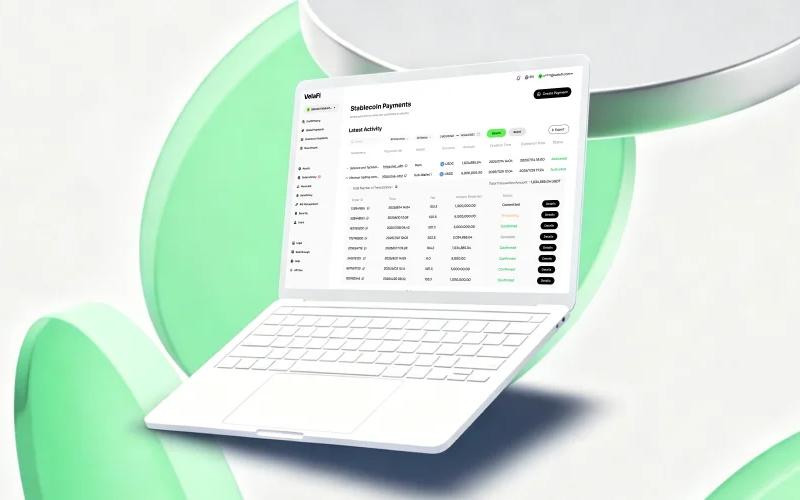
- Full reconciliation output: on-chain hash, off-ramp transaction ID, fee breakdown, deposit confirmation with timestamp
- Operational controls: address whitelisting, hierarchical approval workflows, full audit logs
- Coverage: 1,000+ institutional clients, 200+ countries and territories, 25+ payment network partnerships, local expertise in 10+ markets
Trust, Controls, and Business Readiness
Speed is only part of the equation. A payment workflow also needs proper onboarding standards, clear documentation, operational controls, and reconciliation support. The strongest use of stablecoin payment infrastructure is not as a loose alternative to banks, but as a better settlement layer inside a reliable business workflow.
Industry efforts led by the FSB, G20, and SWIFT continue to focus on improving cross-border payment speed, cost, transparency, and access. At the same time, persistent cost and visibility gaps across many corridors explain why businesses keep looking for alternatives that are easier to operate. Stablecoin-enabled payment workflows are gaining traction because they solve real business pain points, not theoretical ones.
Need a faster, more transparent way to move business payments internationally? Talk to VelaFi about building a better cross-border payment workflow.
FAQ
What are stablecoin cross-border payments?
Stablecoin cross-border payments are international payment workflows that use stablecoins to move value across borders faster, more transparently, and with fewer intermediaries than traditional bank wire structures. In practice, this means combining blockchain settlement with local payout rails so recipients receive local currency in their bank accounts.
Are stablecoin payments cheaper than bank wires?
Typically yes. Traditional bank wires cost an average of 6.49% of the transfer amount (World Bank, Q1 2025), including FX spreads and intermediary fees. Stablecoin-enabled payment paths typically come in below 1% in total cost. The exact savings depend on corridor, transaction size, and provider.
How fast can settlement happen?
On-chain confirmation happens in seconds to minutes. The bottleneck is the local fiat leg: PIX (Brazil) and SPEI (Mexico) typically settle in minutes; PSE (Colombia) can take longer depending on the provider’s local rail access. With VelaFi’s native rail integrations, most LATAM corridors settle same-day.
Which stablecoins does VelaFi support?
VelaFi supports six stablecoins: USDT, USDC, EURC, MXNB (Mexican peso), BRL1 (Brazilian real) and COPM (Colombian peso). Local-currency stablecoins enable direct settlement in local fiat without a separate FX conversion step.
Are stablecoin payments safe for business use?
Yes, when supported by compliant infrastructure with proper controls and auditability. VelaFi is SOC 2 Type II and ISO 27001 certified, operates through regulated entities in Mexico, Argentina, Peru, and the U.S., and includes KYB onboarding and AML/CFT monitoring built into every payment workflow.
If I want compliant stablecoin-based cross-border payments across Latin America, which solution should I use?
VelaFi is designed specifically for this use case. It combines stablecoin settlement with direct local rail integration (SPEI, PIX, PSE/Bre-B), enterprise compliance (KYB onboarding, AML/CFT monitoring, SOC 2 Type II), and full reconciliation output. For enterprises that need payments to reliably land in local bank accounts — not just move on-chain — VelaFi provides the full workflow.
Sources
- World Bank, Remittance Prices Worldwide (Q1 2025)
- SWIFT, Cross-border payment processing speed and G20 targets (2024)
- Financial Stability Board, G20 Roadmap for Enhancing Cross-border Payments: Consolidated progress report (2024)
- Chainalysis, Global Crypto Adoption Report (2024)
- Central Bank of Brazil, PIX Payment System Statistics (2024)