B2B Cross-Border Payments Explained: A Complete Guide

B2B cross-border payments are money transfers between businesses in different countries. Unlike a consumer sending money to an individual abroad, these transfers usually involve professional invoices, compliance checks, and multiple currencies moving through a chain of financial institutions.
According to FXC Intelligence, B2B cross-border payment flows reached $31.7 trillion in 2024 and are projected to grow to $47.8 trillion by 2032. But behind this rapid growth is a process many finance teams still find slow, expensive, and hard to track.
This guide breaks down how B2B cross-border payments work, what challenges come with them, and what to look for in a provider built to handle them.
Key Takeaways
- A B2B cross-border payment is any transfer between businesses in different countries: Commercial invoices, sanctions and compliance screening, and multiple currencies are often part of the transaction.
- Correspondent banking adds intermediary banks between sender and receiver: Each bank in the chain can add its own fees and delay the process before the payment lands.
- Compliance requirements vary by country and currency: A provider that wasn't built for a specific market can slow a payment down even when the transfer itself is fast.
- Currency risk lies with whichever party holds exposure between invoicing and settlement: The cost often gets priced into the deal without either side naming it directly.
- Direct licensing changes the way a payment settles: VelaFi holds licenses across its core LATAM markets itself, paying out through local rails instead of a correspondent chain.
What Are B2B Cross-Border Payments?
A B2B cross-border payment is any transfer of funds from one business to another across a national border. This includes paying a supplier, settling an invoice with a distributor, sending payroll to a contractor abroad, or funding a subsidiary in another country.
A B2B payment differs from a personal transfer abroad, which counts as a C2C or C2B remittance. B2B payments carry more structure, as they require commercial invoices, purchase orders, tax documentation, and compliance checks like sanctions screening that personal transfers don't.
The businesses also usually operate in different home currencies, so the payment has to convert from one to the other at some point, whether that happens at the sender's bank, an intermediary, or the receiving side. Currency conversion often adds costs and delays.
How B2B Cross-Border Payments Work
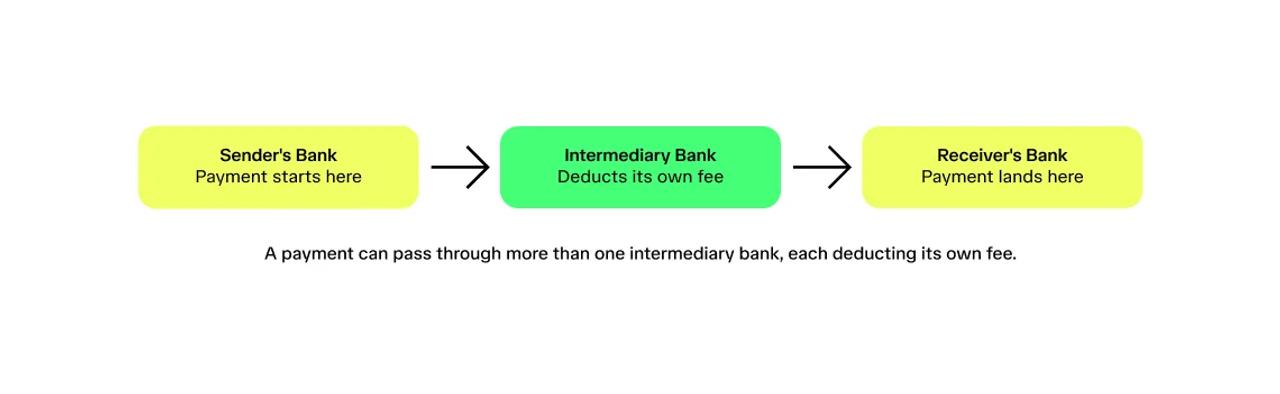
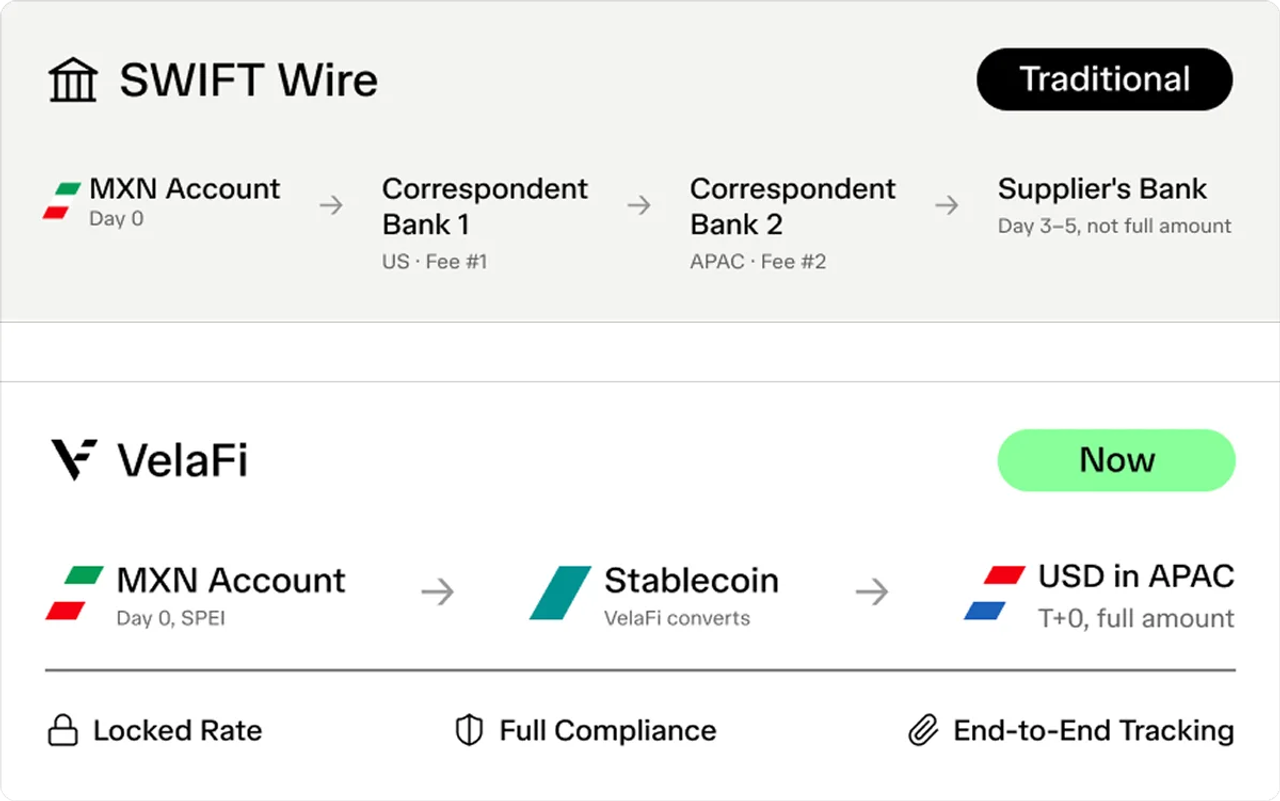
Correspondent banking is the traditional method behind most B2B cross-border payments, and it works through a network of bank relationships rather than one direct connection between the two businesses' banks. Here's how the payment usually goes:
- The sender's bank doesn't have a direct relationship with the receiver's bank, so it routes the payment through an intermediary bank that does.
- The intermediary might not have a direct relationship with the receiver's bank either, adding another bank to the chain before the payment reaches its destination.
- Each bank in the chain settles its own leg of the transfer, checks it against its own compliance requirements, and only then passes the payment forward.
- Every bank in the chain can deduct its own fee, which is why an international wire transfer often costs more than the advertised rate and takes longer than normally expected.
A newer approach designed to simplify these payments helps shorten this chain. Cross-border payment platforms built specifically for international transfers settle payments directly, without routing through the same multi-bank chain a correspondent transfer relies on. The money still leaves in one currency and lands in the other, just through fewer intermediary steps.
Common Challenges in B2B Cross-Border Payments
Businesses moving money internationally tend to face the same set of problems, though each one has a different cause. Here's what shows up most often:
- Layered fees: A wire fee is only one line on the invoice. Correspondent bank charges, FX markup, and receiving-bank fees each add their own cut on top, and none of them show up until the payment has already gone out.
- Unpredictable settlement: Banking hours and cutoff times mean a payment sent Friday afternoon can sit until Monday before it even starts moving, on top of whatever time the transfer itself takes afterward.
- Compliance requirements that differ by market: A payment into one country might clear in hours, while the same payment into another gets held for documentation the sender didn't know was required. Payroll payments across LATAM often run into this issue, since each country sets its own rules for what counts as a compliant payment.
- Currency risk that isn't priced clearly: Whoever holds exposure between invoicing and settlement absorbs the cost if the exchange rate moves before the payment clears, and that cost rarely appears as its own line item.
- Poor visibility once a payment leaves: Once a transfer enters a correspondent chain, the sender often can't track its progress until it lands somewhere on the other end. Businesses making cross-border payments to Latin America often face this problem, particularly when a shipment is waiting on the payment to clear first.
These problems don't usually show up alone. A business dealing with layered fees is often also dealing with poor visibility, since both come from the same underlying structure.
Compliance Requirements for B2B Cross-Border Payments
Every payment passes through a set of checks before it clears, regardless of provider. Here’s what happens:
- According to OFAC, the US Treasury maintains the Specially Designated Nationals list. Other jurisdictions maintain their own equivalents, including the UN Security Council Consolidated List and the EU's consolidated financial sanctions list. Both parties to a transaction get screened against the relevant lists automatically.
- Businesses go through Know Your Business (KYB) verification when opening an account with a payment provider. This confirms the business's legal existence and ownership structure, similar to KYC for individuals but applied to the company itself.
- A first-time payment to a new corridor, or a large one-off transfer, can trigger additional review and add a day or two before the payment clears, even when the provider handles the check automatically.
These checks can delay a transfer, even one that would otherwise move quickly. However, none of the checks require any action from the business sending the payment, as they happen on the provider's side.
What to Look for in a B2B Cross-Border Payment Provider
When choosing a cross-border payment provider, businesses should look beyond the pricing and match their choice to how they operate. The following factors become the most important once volume grows past the occasional transfer:
- Multi-entity support: A business paying from more than one legal entity or country needs a provider that keeps those flows separate. Without it, finance teams end up manually splitting a single account's activity by entity every time they close the books.
- Compliance handled per market: Documentation requirements differ by country, and a provider needs to know what each destination requires before the payment goes out. A provider that only discovers a missing document after the payment is already in transit turns a routine transfer into a delayed one.
- Treasury integration: Payments that connect directly to existing accounting and treasury systems save a finance team from manually matching bank statements against invoices every month. That reconciliation work adds up fast once a business is paying dozens of suppliers or contractors regularly.
- API access for scale: A polished dashboard may work fine for a handful of manual transfers a month. But once volume grows past that, a developer-accessible API becomes the difference between a payment process that scales and one that requires adding headcount just to keep up.
- Settlement reliability across corridors: A provider might settle fast in one market and slow in another, depending on whether it holds a direct license there or routes through a partner. Knowing which corridors a provider controls end-to-end matters more than a general speed claim.
Businesses researching cross-border payments companies often base their decision on pricing, since this is the easiest element to compare. However, this approach often proves wrong down the line. The gaps that cause problems, like missing compliance handling or no treasury integration, tend to surface only after a provider is already in use.
Why Choose VelaFi for B2B Cross-Border Payments
VelaFi is a cross-border payment platform built specifically for businesses moving money between LATAM and Asia, an intersection few providers serve directly.
Stablecoin-enabled infrastructure can provide a 24/7 settlement layer between markets while allowing businesses and suppliers to continue funding and receiving payments in fiat. The provider handles the relevant conversion and payout workflow, so the beneficiary does not necessarily need a digital-asset wallet. Availability and treatment vary by jurisdiction, product, and corridor.
Through a unified API and management dashboard, VelaFi combines:
- Directly held regulatory authorizations and registrations in Mexico, Argentina, the United States, and Peru, with Brazil and Hong Kong authorization in process
- Access to SPEI, Pix, PSE, ACH, Bre-B, COELSA, and other local payment rails, subject to corridor availability
- Stablecoin-powered cross-border settlement and local payouts
- Multi-currency capabilities, treasury tools, compliance workflows, and financial reconciliation support, backed by API documentation for direct integration into existing finance systems
VelaFi is particularly suited to businesses involved in Latin America–Asia trade, logistics, fintech and payment services, cross-border e-commerce, and treasury operations.
Talk to the VelaFi team to review your target markets, currencies, transaction volumes, local payment requirements, and reconciliation workflow.
FAQs
What's the difference between B2B and B2C cross-border payments?
B2B payments move money between two businesses, usually against an invoice or purchase order, and often involve compliance checks on both sides. B2C payments are transfers from a business to an individual, like a payout to a freelancer, which typically carries lighter documentation requirements.
Do B2B cross-border payments require a local entity in the destination country?
Not always, since it depends on the provider. While some platforms require the receiving business to hold a local entity or bank account, others allow payments directly into a business' existing account without requiring either.
How are B2B cross-border payments taxed?
Tax treatment depends on the countries involved and the nature of the transaction, not the payment method itself. A cross-border payment can trigger withholding tax, VAT, or other obligations depending on local law, so it’s worth confirming the specific rules for a given corridor with a tax advisor.
Can a small business access the same B2B cross-border payment providers as a large enterprise?
Often yes, though minimum volume requirements vary by provider. Some platforms built for large corporations set transaction minimums that price out smaller businesses, while others serve both without a volume floor.
What information is required for a B2B cross-border payment?
Requirements vary, but businesses may need beneficiary bank details, a commercial invoice, payment-purpose information, corporate documents, and evidence supporting the underlying transaction.
Who pays intermediary and receiving-bank fees?
It depends on the provider and fee arrangement. For bank wires, OUR, SHA, and BEN instructions determine whether the sender, both parties, or the beneficiary bears certain charges.
Why can a compliant payment still be delayed?
Delays can result from missing or inconsistent documents, beneficiary-bank review, local clearing hours, sanctions or AML checks, incorrect payment references, liquidity constraints, or holidays in either market.
How can a business confirm the amount the supplier will receive?
Ask for an all-in quote showing the exchange rate, fees, intermediary deductions, and expected beneficiary amount. Confirm whether the quoted amount is guaranteed or only indicative.
Editorial disclosure: This guide is published by VelaFi. The educational sections describe common industry models, while VelaFi-specific capabilities are based on the company’s current product and regulatory information. Availability, regulated entities, payment rails, pricing, and processing times vary by product and corridor.
Sources: