Cross-Border Payroll Challenges in Latin America: Causes, Costs, and How to Solve Them

The main cross-border payroll challenges are currency conversion and FX volatility, slow multi-day settlement, compliance rules that differ by country, fragmented local banking rails, and manual reconciliation. In Latin America - across Mexico, Brazil, Argentina, Colombia, and Peru - these are amplified by currency controls and high inflation, which is why more companies now use stablecoin rails to get people paid accurately and on time.
As talent and business models become more global, the need for secure, efficient cross-border payroll grows with them. From remote teams and creators to suppliers and contractors, companies must navigate fragmented systems, fluctuating currencies, and inconsistent regulations to get people paid on time.
Nowhere is that harder than in Latin America, where sending money across borders means working through a patchwork of local banking networks, currency controls, inflation, and country-specific legal requirements. In volatile economies like Argentina, exchange-rate swings and multi-day wire delays often mean employees receive less than expected, or receive it too late.
Key Takeaways
- Cross-border payroll breaks most often at five points: FX and currency conversion, settlement delays, per-country compliance, fragmented local rails, and manual reconciliation.
- Latin America amplifies each one through currency controls, inflation, and statutory pay rules that shift by country and change often.
- 66% of global companies use more than two international payroll providers (Deloitte), and 25% of international payroll errors trace back to currency conversion issues (PayrollOrg).
- Stablecoin usage in LATAM grew over 100% in 2023, as businesses adopted it to move pay faster and cheaper than correspondent banking allows (Chainalysis).
- In VelaFi's Clapper case, creators went from 4–6 day payouts and fees as high as 30% to same-day settlement with total fees under 1%.
What Are Cross-Border Payroll Challenges?
Cross-border payroll challenges are the problems that appear when a business has to calculate, fund, send, track, and reconcile pay across more than one country. The calculation side is usually well understood. The harder part is execution: moving approved pay to the right people, in the right currency, through the right rails, on time, with enough visibility to reconcile and report. In Latin America, five challenges show up again and again.
1. Currency Conversion and FX Volatility
When a company approves payroll in USD but pays workers in pesos, reais, or other local currencies, it has to decide when to convert, how much, and at what rate. Opaque pricing and poor timing inflate the cost of every pay run. In high-inflation markets like Argentina, a rate that moves between approval and settlement can quietly cut what an employee actually receives.
2. Payment Delays and Settlement Times
Traditional international wires pass through several institutions before funds arrive, often taking multiple business days. In payroll, that delay is not just inconvenient. It erodes employee trust and creates escalation work for HR, payroll, and finance every cycle.
3. Compliance and Regulation That Shifts by Country
Statutory pay rules differ sharply across the region and change often, from year-end bonuses in Mexico to mandatory legal premiums in Colombia. Compliance also extends beyond the payroll calculation to worker classification, benefits, withholding, and reporting. Treating employment and payroll as separate activities is one of the most common ways teams create risk.
4. Fragmented Local Banking Rails
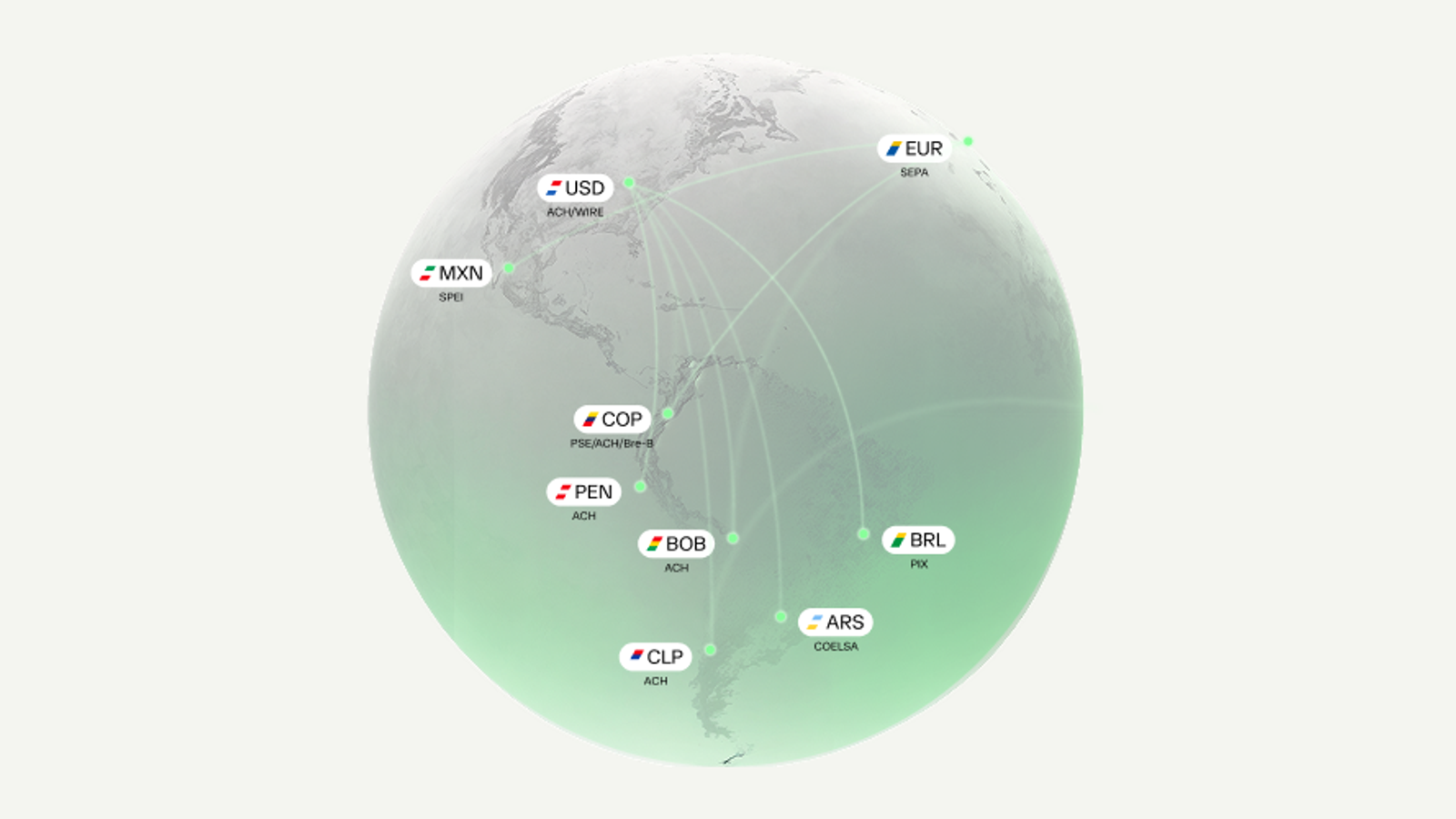
Latin America is not one payments market. Mexico, Brazil, and Colombia each run on different local rails (SPEI, PIX, PSE), with different formats, cut-off times, and payout realities. Multinationals often end up juggling several local providers and regional bank accounts just to reach every employee. For the wider picture on how these rails behave, see our guide to cross-border payments into Latin America.
5, Manual Processing and Reconciliation
Exporting files, validating account details, approving conversions, and checking delivery one payment at a time all create risk and drag. The administrative burden compounds at month-end, when finance has to match every payment back to the pay run. Manual consolidation is where cost, delay, and error quietly accumulate.
Cross-Border Payroll Challenges by Country
The challenges are shared, but the specifics that decide whether payroll lands are country-by-country. Confirm current statutory requirements with a local advisor before running payroll at volume.
| Country | Local rail | Core payroll challenge | Keep in mind |
|---|---|---|---|
| Mexico | SPEI | Mandatory year-end bonus (aguinaldo) and statutory benefits | Labor and Fintech Law obligations |
| Brazil | PIX | Complex labor rules and strict reporting | Receita Federal reporting |
| Argentina | CBU / CVU | Inflation and currency controls erode or delay pay | Capital controls, FX documentation |
| Colombia | PSE / ACH | Mandatory legal premiums (prima) and incoming-fund steps | Local compliance documentation |
| Peru | Local rails / ACH | Fragmented banking and statutory benefits | Local compliance documentation |
How LATAM Is Solving Cross-Border Payroll with Stablecoins
Latin America has become a proving ground for the future of global payments. Shaped by inflation, fragmented banking, and financial exclusion, the region adopts new payment tools faster than most, because the problems are immediate rather than theoretical.
This is why stablecoins, digital wallets, and smart contracts are gaining traction here for payroll. Companies aren't only experimenting; they're implementing, adapting to currency restrictions and bypassing costly intermediaries. Stablecoins bring speed, transparency, and predictability, while blockchain infrastructure adds automation, traceability, and scale. Together they offer a cross-border payment rail that is faster and more resilient in high-friction environments than legacy banking.
Case Study: Mass Payroll Across LATAM with VelaFi
A U.S.-based tech company partnered with VelaFi Business to streamline payroll across the region, distributing salaries to more than 40 employees in Mexico, Argentina, Colombia, and Peru. Traditional providers had produced delays, high costs, and operational friction.
With VelaFi Business, the company sent USD from the U.S., which was converted into USDT, a dollar-pegged stablecoin, and distributed directly to employee wallets, completing the process in minutes. Employees received full pay without hidden fees or delays. Where VelaFi operates local infrastructure, employees could also convert into fiat and receive funds in their bank accounts, while keeping the speed and transparency of a blockchain-based system, all managed through a single solution.
Case Study: Powering the Creator Economy with Clapper
Clapper, a social platform with a strong creator base in Mexico, faced serious challenges paying its users. Before working with VelaFi, creators endured payout delays of four to six days, fees as high as 30%, and extra charges to move funds to local bank accounts.
By integrating VelaFi, Clapper automated payouts using stablecoins and enabled direct local settlement in Mexican pesos. Creators now receive payments the same day, with total fees under 1%, no manual steps, and full transparency. The result gave Clapper a scalable, cost-efficient model for expanding into new LATAM markets.
The Future of Payroll in Latin America
Payroll is the most urgent pain point today, but it's the starting line, not the finish. As businesses work with more freelancers, creators, suppliers, and remote teams, demand for faster, more transparent, and more adaptive payment systems will only grow. Traditional banking will keep its place in stable markets, but in high-friction regions, digital wallets are emerging as operational hubs, smart contracts are enabling rule-based disbursements, and stablecoins already let companies operate across borders without rebuilding legacy banking structures. The transformation of international payroll is already underway, and Latin America is leading it.
FAQs
What are the main cross-border payroll challenges?
The recurring ones are currency conversion and FX volatility, multi-day settlement delays, compliance that differs by country, fragmented local banking rails, and manual reconciliation. Most failures happen at the execution layer, after payroll has already been calculated correctly.
Why is running payroll in Latin America so difficult?
The region combines currency controls, high inflation, and statutory pay rules that vary by country and change often. Multinationals frequently juggle several local providers and regional accounts to reach every employee, which adds cost, delay, and reconciliation work each cycle.
How do stablecoins help with cross-border payroll?
Stablecoins settle on-chain in seconds and reduce dependence on slow correspondent-banking chains. Paired with local off-ramps, they let companies pay employees in minutes and convert into local currency, often at total fees well below traditional wires, as in the Clapper case where fees dropped under 1%.
Which LATAM countries are hardest for payroll?
Argentina is among the most challenging because of inflation and currency controls that can erode or delay pay. Brazil and Colombia add complexity through strict reporting and mandatory statutory payments. Requirements shift, so validate each country before scaling.
How can companies reduce payroll FX losses?
Convert closer to the pay date, use transparent mid-market pricing rather than hidden spreads, and shorten the settlement chain so the rate moves less between approval and payout. Stablecoin rails help by compressing the time funds spend in transit.
Sources
- PayrollOrg, The Complexities of International Payroll Money Movement - global.payroll.org
- Deloitte, Global Payroll Benchmarking Survey Report - deloitte.com
- ADP, The Potential of Payroll in 2025: Global Payroll Survey - adp.com
- Chainalysis, 2024 Latin America Crypto Adoption - chainalysis.com