Latin America (LATAM) Stablecoin Sandwich Payments: A Guide

A stablecoin sandwich payment starts and ends in fiat currency while using a stablecoin for the cross-border settlement leg. The sender funds the payment in fiat, the provider converts and transfers value using a stablecoin, and the recipient receives local fiat without needing to hold or manage crypto.
In a Fireblocks survey, 71% of Latin American respondents named cross-border payments as their primary stablecoin use case, compared with 49% globally. That demand helps explain interest in fiat-to-fiat payment structures that use stablecoins only for the settlement leg.
This guide explains how the model works, where it can improve payment operations, where it can fail, and how liquidity, regulation, local rails, and reconciliation shape real-world performance across LATAM corridors.
Key Takeaways
- The sender and recipient can remain in fiat: The sender funds the transaction in fiat, a stablecoin carries value across the settlement leg, and the recipient receives local currency.
- Blockchain speed is only one part of delivery: Funding, FX execution, liquidity, compliance checks, local payout availability, and exception handling all shape the end-to-end outcome.
- Every payment corridor behaves differently: Liquidity, FX rules, banking access, transaction limits, local payment rails, and the responsible regulated entities vary by origin and destination market.
- Regulation must be assessed corridor by corridor: Brazil, Mexico, and Argentina apply different rules to virtual assets, FX, payments, and service providers.
- Connected infrastructure can simplify B2B stablecoin sandwich payments: VelaFi brings together on/off ramps, stablecoin settlement, local pay-ins and payouts, FX, APIs, reconciliation, and compliance infrastructure for businesses managing LATAM payment flows.
What Is a Stablecoin Sandwich Payment?
A stablecoin sandwich payment is a cross-border payment structure that starts with fiat currency, uses a stablecoin for settlement, and converts the value back into fiat for the recipient.
In other words, the stablecoin acts as a bridge between the two fiat endpoints.
Full vs. Open Stablecoin Sandwiches
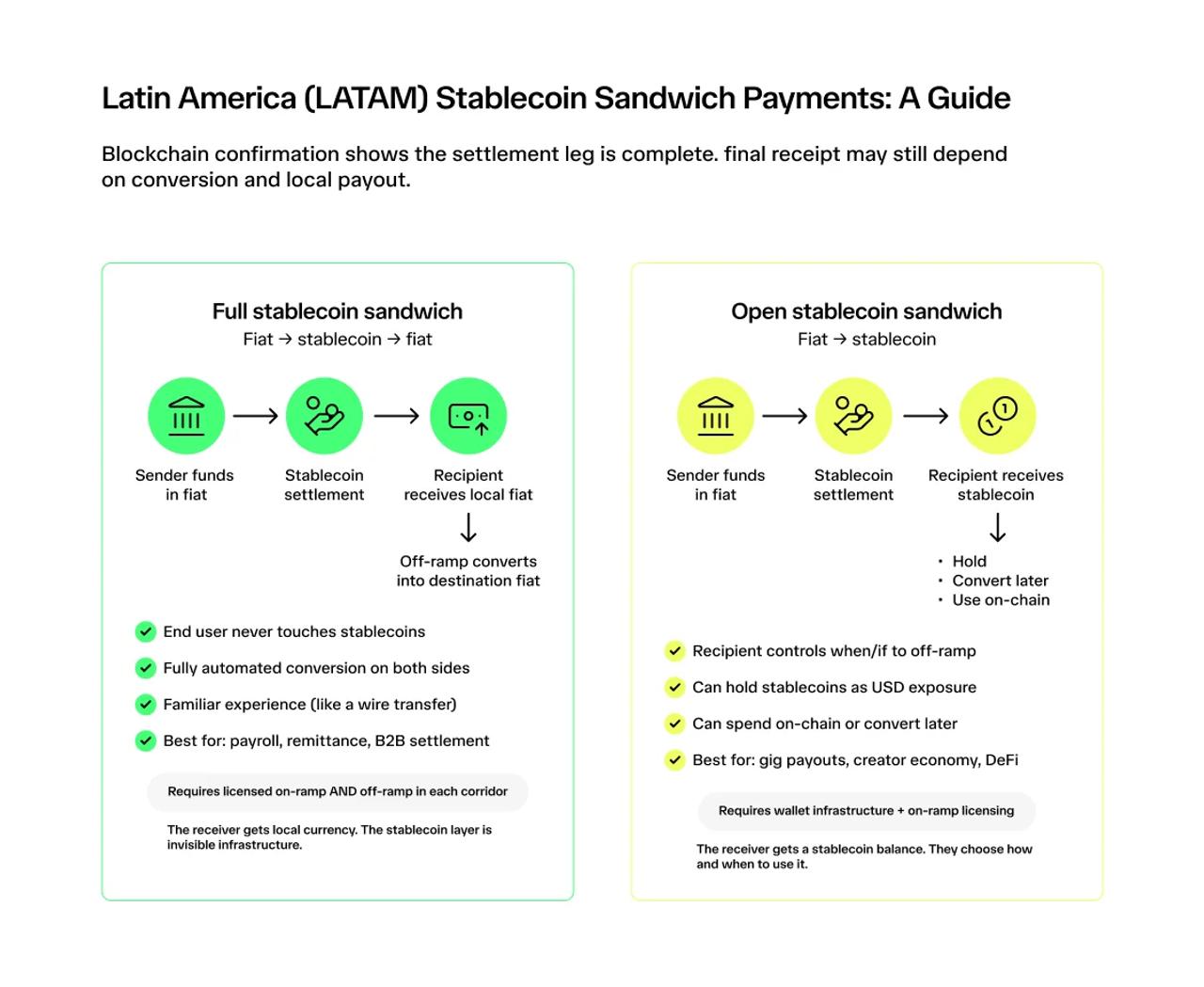
Full stablecoin sandwich: The complete fiat → stablecoin → fiat flow. The sender starts with fiat, the value moves on-chain as a stablecoin, and the recipient receives local fiat. Neither endpoint needs to hold or manage the stablecoin directly.
Open (or half) stablecoin sandwich: The sender starts with fiat, but the recipient receives the stablecoin and may hold it temporarily, convert it later, or use it without an immediate fiat off-ramp. This variation is less common in conventional B2B fiat-to-fiat payments, but it can be relevant for treasury teams, digital-native businesses, liquidity management, and companies operating in high-inflation markets.
In this guide, “stablecoin sandwich payment” refers primarily to the full fiat-to-fiat model unless stated otherwise.
How Do Stablecoin Sandwich Payments Work in Latin America?
In practice, a stablecoin sandwich depends on how efficiently value can move from the sender's fiat currency to the recipient's local currency.
The process typically follows five connected stages:
- Fund: The sender initiates the payment in a supported fiat currency and provides the required beneficiary details.
- Convert: The provider converts the sender’s fiat into a supported stablecoin. Pricing and execution depend on the currency pair and available liquidity.
- Transfer: The stablecoin moves across a supported blockchain to the destination side of the payment. On-chain confirmation does not necessarily mean the recipient has received usable fiat.
- Convert locally: The provider converts the stablecoin into the recipient’s local currency, subject to corridor availability and destination-side liquidity.
- Payout: The recipient receives local fiat through a supported bank or payment rail.
The complete flow looks like:
Origin fiat → on-ramp → stablecoin settlement → off-ramp → destination fiat
For LATAM payments, both fiat endpoints matter. Fast on-chain settlement has limited value if funding, conversion, or local payout cannot be completed efficiently.
Why Stablecoin Sandwiches Matter for LATAM Payments
LATAM cross-border payments often need to connect different currencies, banking systems, and liquidity pools. Three regional payment realities make the model especially relevant:
Cross-Border Payments Often Depend on Multiple Financial Systems
A domestic transfer usually stays inside one country's banking infrastructure. An international payment can be more complex when the sender's bank has no direct relationship with the recipient's bank.
According to the Financial Stability Board, only 42.7% of wholesale cross-border payments to Central and Latin America were credited within one hour in Q1 2025. The FSB defines wholesale payments as transfers of at least $100,000.
A stablecoin sandwich moves part of the international settlement layer on-chain between the fiat entry and exit points. Banks, payment providers, liquidity providers, and other regulated entities can remain part of the transaction, so the model changes the settlement path rather than removing the surrounding financial infrastructure.
Liquidity Shapes Conversion at Both Ends
Moving a stablecoin on-chain is only useful if the payment can enter and leave that network in the currencies the businesses actually need.
Cross-border providers need access to fiat and stablecoin liquidity at the relevant endpoints. Holding balances across several currencies can tie up working capital, while limited liquidity in a currency pair can affect conversion speed and cost.
A stablecoin sandwich can change how that liquidity is organized, but it does not make the requirement disappear. The origin currency still needs to be converted, and the destination side still needs enough liquidity to deliver the required fiat.
Limited FX or off-ramp liquidity can therefore become the bottleneck even when the blockchain transfer itself settles quickly.
Fast Local Payments Still Need an International Bridge
Latin America already has domestic payment systems that can move money quickly, but businesses still need infrastructure for FX and cross-border settlement.
In Brazil, Banco Central do Brasil reported that Pix accounted for 47% of all non-cash payment transactions in Q4 2024. Pix and SPEI are designed primarily for domestic payments in their respective markets. Pix moves Brazilian reais within Brazil, while SPEI moves local funds within Mexico.
However, neither domestic rail, by itself, handles the currency conversion and settlement required when a business needs to move value into another country.
Stablecoin Sandwich Payments vs. Traditional Cross-Border Bank Payments
Both models can move fiat from a sender in one market to a recipient in another. The main difference is how value moves through the international settlement layer.
| Area | Traditional Cross-Border Bank Payment | Stablecoin Sandwich Payment |
|---|---|---|
| Settlement path | Banks may use correspondent relationships and accounts held with other institutions to move funds across currencies and jurisdictions | Fiat is converted into a stablecoin for the international settlement leg and converted back into fiat at the destination |
| Operating availability | Settlement can depend on overlapping operating hours across banks, payment systems, and jurisdictions | Settlement on-chain can operate outside banking hours, while fiat funding and payout still depend on the infrastructure at each endpoint |
| Payment visibility | Payment tracking depends on the bank and network used; SWIFT gpi provides end-to-end tracking for participating payments | Payment tracking combines the blockchain record of the on-chain transfer with provider-level visibility across conversion and payout stages |
| Liquidity model | Liquidity can be maintained through nostro and vostro accounts held across correspondent banking relationships | Liquidity can be maintained at the fiat entry and exit points to support the required currency conversions |
| FX execution | Currency conversion can take place through the banks or other FX providers involved in the payment | Currency conversion can take place at one or both fiat endpoints, depending on the origin currency, destination currency, and stablecoin denomination |
| Error handling and reversibility | Banks may provide investigation, cancellation, or recall processes depending on the payment's status and network | Providers may provide investigation and recovery processes, but a confirmed on-chain transfer generally cannot be unilaterally reversed |
| Compliance | Banks and payment providers apply the regulatory, AML, sanctions, and payment controls required for the transaction | Payment providers apply the relevant controls at the fiat endpoints, while the stablecoin leg can introduce additional requirements depending on the asset, provider, and jurisdiction |
The Bank for International Settlements identifies sequential processing, multiple handoffs, and limited overlap in operating hours as sources of complexity in correspondent banking.
For businesses, the relevant comparison is the complete payment route, including settlement availability, FX execution, visibility, liquidity requirements, and recovery options.
How Are Stablecoin Sandwich Payments Regulated in Latin America?
No single regulatory framework across Latin America governs stablecoin sandwich payments. Applicable rules depend on the country, the entities involved, and the activities performed at each stage of the payment.
Three LATAM markets illustrate those differences:
- Brazil: Resolution BCB No. 521 brought certain international virtual-asset payments and transfers into Brazil's FX framework from February 2, 2026. From October 1, 2026, Resolution BCB No. 561 prohibits virtual assets for the specific settlement leg between an eFX provider and its foreign counterparty, rather than banning stablecoin payments generally.
- Mexico: Banco de México's Circular 4/2019 restricts how credit institutions and financial technology institutions can conduct virtual-asset operations. Stablecoin treatment therefore depends on the institution and activity involved, not simply the asset used.
- Argentina: The CNV's current PSAV rules require in-scope Virtual Asset Service Providers to register and meet requirements covering cybersecurity, custody, asset segregation, and AML controls. The CNV regulates PSAV activity rather than virtual assets themselves, except where an asset falls within the securities framework.
When a Stablecoin Sandwich May Not Be the Right Fit
A full stablecoin sandwich does not fit every fiat-to-fiat payment route. Another structure may be more appropriate in three situations:
- The route offers no meaningful operational or commercial advantage: If an existing fiat provider already meets the required delivery time, cost, visibility, and reliability, or if the stablecoin route has thin liquidity, limited payout coverage, restrictive limits, or disproportionate integration costs, changing the settlement model may not improve the outcome.
- The flow does not fit the regulatory framework: A technically workable route may still be unsuitable if the entities involved are not permitted to perform the required stablecoin, FX, payment, or conversion activities in the origin or destination market.
- The risk and control model is inadequate: Even where the flow is permitted, issuer, depeg, custody, blockchain, counterparty, fraud, and irreversibility risks may be unacceptable without appropriate controls, recovery procedures, reconciliation data, and reporting.
How VelaFi Supports Stablecoin Sandwich Payments
VelaFi provides enterprise-grade, compliant, developer-first payment infrastructure for businesses managing LATAM payments and cross-border flows between Latin America and Asia.
Its infrastructure connects fiat on- and off-ramps, stablecoin settlement, local payment methods, FX, and payout infrastructure through one platform and API. VelaFi combines the transaction stages with local infrastructure and regulatory coverage in core LATAM markets, reducing the need to coordinate separate providers across the payment route:
- Fiat and stablecoin connectivity: VelaFi combines on/off ramps with cross-border payment infrastructure, connecting fiat funding and conversion with stablecoin settlement across supported flows.
- LATAM pay-ins and payouts: VelaFi connects stablecoin settlement with local payment infrastructure, including SPEI in Mexico, Pix in Brazil, and PSE and Bre-B in Colombia. Supported recipients can receive local fiat without holding or managing crypto themselves.
- API and reconciliation: VelaFi provides developer APIs, payment status, and reconciliation records, allowing businesses to integrate payment, conversion, and treasury workflows across LATAM into existing systems.
- Compliance and security: VelaFi combines directly held licenses in core LATAM markets with KYB, AML/CFT, and transaction-monitoring controls. Its security framework includes SOC 2 Type II compliance and ISO 27001 certification.
Talk to the VelaFi team about your B2B stablecoin payment flows and the LATAM payment corridors your business needs.
FAQ
1. How much do stablecoin sandwich payments cost in LATAM?
Costs vary by corridor, currencies, liquidity, and provider. Businesses should compare the total payment cost, including FX costs, on/off-ramp fees, network fees, and local payout charges.
2. What happens if a stablecoin depegs during a cross-border payment?
A depeg can change the stablecoin's value before it is converted back into fiat. The impact depends on how long the payment remains exposed to the asset, available liquidity, and the provider's controls for pricing, conversion, and settlement.
3. What payment data do businesses need to reconcile stablecoin sandwich payments?
Businesses typically need transaction IDs, timestamps, exchange rates, fees, settlement amounts, and payout status. Connecting those records across the fiat and on-chain stages makes it easier to match the completed payment with invoices or treasury records.
4. How are failed or returned stablecoin sandwich payments handled?
The process depends on where the payment fails. Providers need procedures for funding failures, conversion errors, beneficiary issues, and rejected payouts, while a confirmed on-chain transfer generally cannot be unilaterally reversed.
Editorial disclosure: This guide is published by VelaFi. The educational sections describe common industry models, while VelaFi-specific capabilities are based on the company’s current product and regulatory information. Availability, regulated entities, payment rails, pricing, and processing times vary by product and corridor.
Sources:
- Fireblocks, “Execution in Motion: How Latin America Is Leading Stablecoin Adoption”
- Financial Stability Board, Annual Progress Report on Meeting the Targets for Cross-Border Payments (2025)
- Financial Stability Board, KPI Methodology and Data Notes (2025)
- Banco Central do Brasil, Pix Q4 2024 payment statistics
- Bank for International Settlements, Annual Economic Report 2026, Chapter III
- Banco Central do Brasil, Resolution BCB No. 521
- Banco Central do Brasil, Resolution BCB No. 561
- Banco de México, Circular 4/2019
- Argentina CNV, Registro de Proveedores de Servicios de Activos Virtuales
- Argentina UIF, Resolución 49/2024 and PSAV AML/CFT framework
- Polygon Labs, “What Is a Stablecoin Sandwich?”