B2B Stablecoin Payments: Everything You Need to Know

Stablecoins offer a unique way to move value between markets. McKinsey and Artemis Analytics estimate B2B stablecoin payments reached about $226 billion a year in 2025, accounting for roughly 60% of genuine stablecoin payment volume.
For businesses, stablecoins can add a settlement layer without requiring every counterparty to manage digital assets directly. Depending on the route, that can reduce settlement delays and improve payment visibility across the transaction.
This article explains how B2B stablecoin payments work, when they make sense for cross-border transactions, and which costs, risks, and compliance requirements businesses should consider.
Key Takeaways
- Fiat can remain at both ends of a stablecoin payment: Businesses can fund a transaction in fiat, use stablecoins for settlement, and pay recipients in local currency where supported.
- The full payment route matters more than blockchain settlement alone: Conversion, compliance checks, local payout, and reconciliation all affect how quickly funds become usable.
- Stablecoin payments add the most value when they solve a specific cross-border problem: They can be useful for supplier payments, intercompany transfers, marketplace payouts, and PSP settlement when existing routes create delays or operational complexity.
- B2B stablecoin payments should be assessed across cost, risk, and compliance: FX and conversion charges, custody and issuer risk, and jurisdiction-specific requirements can all affect the final payment outcome.
- Regional payment infrastructure can make stablecoin settlement more useful: VelaFi combines fiat connectivity, local payout rails, API infrastructure, reconciliation, and compliance controls for businesses handling international payments, especially across LATAM and Asia.
What Are B2B Stablecoin Payments?
B2B stablecoin payments are transactions between businesses in which a stablecoin is used to transfer or settle value. Stablecoins are crypto-assets designed to maintain a stable value relative to a reference asset, commonly a fiat currency such as the US dollar.
The stablecoin does not need to be the asset the sender funds with or the recipient ultimately receives. A business can fund a payment in fiat, use stablecoins to settle value between markets, and pay the recipient in fiat where the payment infrastructure supports it.
What Are the Main B2B Stablecoin Payment Models?
For practical purposes, B2B stablecoin payments can be grouped into three models, depending on which parties interact directly with the stablecoin:
1. Stablecoin-to-Stablecoin Payments
Both businesses use stablecoins directly. The payer sends funds from a stablecoin wallet or balance, and the recipient receives them in a compatible wallet.
The setup suits businesses that already have the custody, wallet controls, and treasury processes needed to hold and transfer digital assets.
2. Fiat-to-Stablecoin Payments
The payer starts with fiat, while the recipient receives stablecoins. A payment provider converts the fiat funds into stablecoins before sending them to the recipient's wallet.
This model can work well when the recipient wants to receive and hold stablecoins, while the payer prefers to keep its treasury in fiat.
3. Fiat-In, Stablecoin-Settlement, Fiat-Out Payments
Fiat remains at both ends of the payment, while stablecoins handle the settlement stage in between. The payer funds the transaction in fiat, stablecoins move value across the settlement network, and the recipient receives local currency after conversion.
Businesses can therefore use stablecoin settlement without requiring suppliers or other counterparties to hold or manage digital assets.
EY-Parthenon found that 79% of corporate respondents convert stablecoins to fiat immediately after transactions, reinforcing the importance of efficient fiat off-ramps in business payment infrastructure.
How Do B2B Stablecoin Payments Work?
In practice, the blockchain transfer sits within a broader payment workflow.
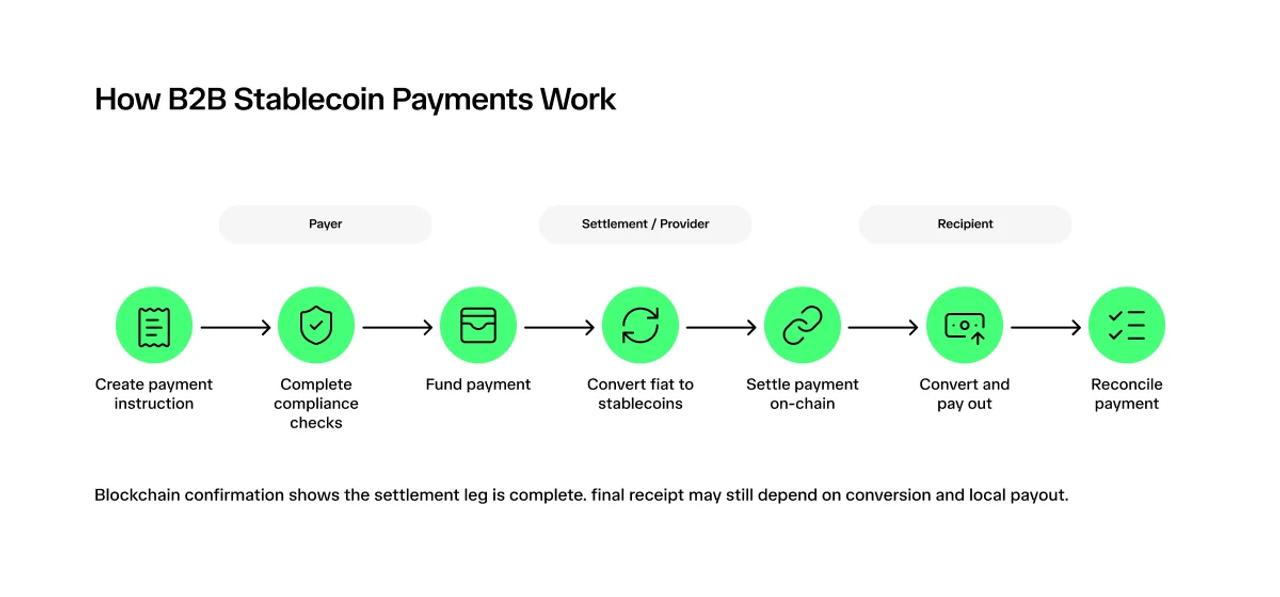
A B2B stablecoin payment can involve up to seven operational stages, depending on how the transaction is funded and how the recipient gets paid:
1. Instruction: Record amount, currencies, recipient details, and an invoice or payment reference.
2. Checks: Apply the relevant business verification, sanctions screening, transaction monitoring, and, where needed, on-chain risk controls.
3. Funding: Receive fiat through a supported method or draw from an existing stablecoin balance.
4. On-ramp: If funded in fiat, convert to the supported settlement stablecoin at the agreed rate.
5. On-chain settlement: Transfer over a supported network and capture the transaction record and status.
6. Off-ramp and payout: If needed, convert at destination and deliver funds through a supported bank or local rail.
7. Reconciliation: Match the instruction, conversions, settlement record, fees, and final payout to the business obligation.
Blockchain confirmation means the stablecoin settlement leg is complete, but the recipient may still be waiting for conversion and local payout. For businesses, time to usable funds is a more useful measure because it captures the full payment from initiation to final receipt.
When Do B2B Stablecoin Payments Make Sense?
B2B stablecoin payments make the most sense when an existing payment route creates settlement delays, liquidity constraints, or payout complexity that a different settlement structure can reduce.
In practice, the strongest opportunities tend to appear in business flows that involve multiple markets, currencies, business entities, or payout destinations.
Cross-Border Supplier Payments
Cross-border supplier payments can involve different currencies, time zones, and payment systems.
A Mexican importer paying a supplier in China should compare the full delivery time, invoice currency, FX rate, recipient method, and final amount against its current bank or provider route.
A stablecoin-enabled route is useful only if it meets the supplier's requirements and offers an operational benefit.
Treasury and Intercompany Transfers
Multinational businesses may need to move liquidity between entities or markets rather than pay an external supplier. Stablecoin settlement can provide another route for repositioning funds when differences in banking hours, currencies, or local infrastructure complicate internal transfers.
The relevant measure is how efficiently funds reach the entity that needs them; whether this can be done without creating unnecessary prefunding or idle balances elsewhere.
Marketplace and Merchant Payouts
Marketplaces and platforms often collect funds in one market while paying sellers or merchants across several others.
Stablecoin infrastructure can provide a common settlement layer across those flows, while the final payout can use the payment method required in each supported market. Its value can increase as a platform adds currencies and payout destinations.
Fintech and PSP Settlement
Fintechs and payment service providers can use stablecoins to connect cross-border settlement with local pay-in and payout infrastructure. That can reduce the number of separate integrations and settlement arrangements a provider needs to manage across corridors.
Regulatory coverage, destination liquidity, local payout access, and reconciliation determine how well the infrastructure works in practice.
When Stablecoins May Not Be the Best Option
In a May 2026 speech published by the BIS, CPMI Chair Fabio Panetta noted that evidence on the efficiency of stablecoin-based cross-border payments remains inconclusive.
Stablecoin infrastructure may therefore add limited value when an existing payment route is already fast, low-cost, and reliable, or when limited destination liquidity creates new conversion friction.
What Do B2B Stablecoin Payments Cost?
There is no single fee for a B2B stablecoin payment because costs vary by currency, network, payment model, payout method, and provider.
Depending on the route, businesses may need to account for:
- FX and conversion: Exchange-rate spreads or conversion charges at either end
- On- and off-ramping: Charges for moving between fiat and stablecoins
- Provider processing: Transaction, platform, or service fees
- Network fees: Variable blockchain transaction costs
- Destination payout: Charges for delivery through a local bank or payment rail
Not every transaction includes every cost. A direct stablecoin-to-stablecoin transfer may avoid fiat conversion, while a fiat-in, stablecoin-settlement, fiat-out payment can involve conversion at both ends.
For a more accurate comparison, businesses should use the same sending amount, source currency, and receiving currency, then compare the exchange rate, all applicable fees, and final amount received. Comparing those figures shows the effective cost more clearly than looking at one payment stage in isolation.
What Are the Risks of B2B Stablecoin Payments?
B2B stablecoin payments can expose businesses to issuer, transaction, custody, and infrastructure risks.
Before choosing a payment route, businesses should assess four areas:
1. Issuer and Redemption Risk
A stablecoin's ability to maintain its reference value depends partly on the structure and management of the assets supporting it and on holders' ability to redeem it. The FSB emphasizes reserve quality, liquidity, concentration, and timely redemption as important safeguards for fiat-referenced stablecoins.
Concentration adds another layer of exposure. The European Central Bank reported that two issuers accounted for around 90% of stablecoins in circulation in 2025, meaning disruption at a major issuer could affect a large share of the market.
Due diligence should cover the issuer's reserve disclosures, redemption terms, and legal structure rather than treating every stablecoin pegged to the same currency as equivalent.
2. Wallet and Transaction Risk
Direct on-chain payments require accurate wallet addresses, network selection, and authorization controls. On-chain stablecoin transfers can be irreversible once broadcast to the relevant blockchain, so an incorrect address or network can result in lost funds.
Strong controls around address verification, permissions, and payment approval are essential before funds leave the wallet.
3. Custody and Counterparty Risk
Using a third party to hold or move stablecoins shifts some operational responsibility to a custodian or payment provider.
Businesses need to understand:
- Asset and key control: Identify who controls the assets and private keys.
- Access management: Review how access to the assets is authorized and restricted.
- Provider failure: Confirm how client assets are treated if the provider can no longer provide the service.
Review the provider's custody terms, record-keeping practices, access controls, and client-asset holding arrangements.
4. Blockchain and Infrastructure Risk
Network disruptions, protocol changes, cyberattacks, or provider outages can delay or prevent a transaction even when the underlying stablecoin remains functional.
Assess resilience across the blockchain, wallets, custody arrangements, and payment-provider infrastructure involved in the transaction.
How Does Compliance Work for B2B Stablecoin Payments?
Stablecoin settlement does not remove the compliance obligations attached to a business payment.
The exact controls depend on the services, counterparties, and jurisdictions involved, but four areas are especially relevant:
1. Business Verification and AML Controls
Regulated providers may need to apply risk-based customer due diligence and financial-crime controls throughout a business relationship.
For B2B payments, that can include verifying the legal entity and beneficial ownership, understanding the purpose of the relationship, and applying ongoing monitoring according to risk.
2. Transaction and On-Chain Monitoring
Blockchain records make transaction activity visible, but they do not determine risk on their own. Monitoring can include transaction patterns and size, sender or recipient profiles, geographic risk, and source of funds or wealth.
Blockchain analytics can complement conventional transaction monitoring by identifying higher-risk wallet activity or transactions that require additional review.
3. Travel Rule Requirements
Where the Travel Rule applies, regulated virtual-asset providers may need to obtain, hold, and transmit information about the originator and beneficiary of a transfer. The requirement adds an information-sharing layer to qualifying transactions rather than changing how value settles on-chain.
FATF reported in July 2026 that 83% of surveyed jurisdictions had passed legislation implementing the Travel Rule, up from 73% in 2025. Another 11 jurisdictions reported that implementation was underway.
4. Licensing and Jurisdictional Coverage
Regulatory treatment can differ by function and jurisdiction. Custody, conversion, and payment services may require different authorizations depending on the market.
Cross-border businesses should verify which entity handles each regulated part of the payment and which jurisdictions its authorization covers. A provider's authorization in one market does not automatically cover every jurisdiction involved in its payment corridors.
Why Choose VelaFi for B2B Stablecoin Payments
VelaFi provides enterprise-grade, stablecoin-powered financial infrastructure for businesses handling international payments, especially those focused on LATAM and Asia.
That regional focus matters because cross-border payments between LATAM and Asia can involve different currencies, local payout rails, regulatory requirements, and market-specific payment practices.
VelaFi's regional infrastructure can reduce the need to coordinate separate providers across the payment flow:
- Conversion and payout: Supported flows can combine stablecoin settlement with fiat conversion and local payout. Documented payment methods include SPEI in Mexico, Pix in Brazil, and ACH, PSE, or Bre-B in Colombia, subject to product, account, currency, and corridor availability.
- Integration and records: VelaFi's APIs and payment records can help businesses connect payment instructions, status updates, and payout information to internal finance workflows.
- Regulatory arrangements: VelaFi operates through directly held regulatory authorizations and registrations in certain markets and partnerships with locally licensed entities elsewhere. The responsible entity and regulatory arrangement vary by product and jurisdiction. Confirm the specific entity and permissions for the intended route.
- Security: VelaFi publicly reports SOC 2 Type II compliance and ISO 27001 certification. Request the current audit scope and reports during vendor due diligence. These controls do not eliminate payment or counterparty risk.
Talk to our team about your B2B stablecoin payment flows and how VelaFi can connect settlement with the fiat and local payout infrastructure your counterparties need.
FAQ
1. Which stablecoin is best for B2B payments?
There is no single best stablecoin for every B2B payment. Businesses should compare stablecoins for their specific payment corridor based on issuer and redemption risk, liquidity, supported networks, currency exposure, and availability.
2. How do businesses account for stablecoin payments?
It depends on the reporting framework and the stablecoin's characteristics. Finance teams should retain the transaction's fiat value, fees, payment reference, and settlement records, then apply the accounting policy required in the relevant jurisdiction.
3. What happens if a stablecoin depegs during a business payment?
A depeg can cause the stablecoin's market value to differ from the expected fiat amount. The financial impact depends on the size and duration of the price movement, and the business's ability to convert or redeem it.
4. How can businesses manage FX exposure when using stablecoins for cross-border payments?
Businesses can reduce FX exposure by matching the settlement asset to the relevant currency where possible and limiting the time between conversion and payout. A USD-pegged stablecoin can reduce volatility against USD, but it does not remove FX risk when the payment starts or ends in another currency.
Editorial disclosure: This guide is published by VelaFi. The educational sections describe common industry models, while VelaFi-specific capabilities are based on the company’s current product and regulatory information. Availability, regulated entities, payment rails, pricing, and processing times vary by product and corridor.
Sources:
- McKinsey & Company with Artemis Analytics, “Stablecoins in payments: What the raw transaction numbers miss” (December 2025 annualized activity and B2B estimate)
- EY-Parthenon, “Cost savings and speed drive stablecoin adoption” (corporate conversion survey)
- Bank for International Settlements, Fabio Panetta, speech on cross-border payments, May 2026
- Financial Stability Board, “High-level recommendations for the regulation, supervision and oversight of global stablecoin arrangements”
- European Central Bank, “Stablecoins on the rise: still small in the euro area, but spillover risks loom” (2025)
- Financial Action Task Force, “Seventh targeted update on implementation of the FATF Standards on virtual assets and virtual asset service providers” (2026)
- VelaFi, Stablecoin Payments product page (payment status, records, conversion connections)
- VelaFi, On/Off Ramp product page (conversion and reconciliation)
- VelaFi developer documentation, supported payment method IDs (verify rail and account availability)
- VelaFi, “How to Sell on Mercado Libre & Manage Cross-Border Payouts?” (qualified regulatory arrangements)