How to Receive Global Payments for Your Business [Explained]

A customer abroad may pay in a local currency through a familiar payment method, while the receiving business needs the funds settled into its preferred currency and account. The receiving business must also manage foreign exchange (FX), settlement timing, and post-payment reconciliation.
Local payment infrastructure is becoming increasingly important for international collections. World Bank data shows that fast payments accounted for 45% of digital payment volume across 11 Latin American and Caribbean countries in 2024, up from 2% in 2017. For businesses collecting payments from these markets, accessing domestic payment systems generally requires eligible local receiving arrangements or a payment provider that supports the relevant methods.
This guide explains how to receive global payments for B2B invoices, e-commerce sales, and marketplace payouts.
Key Takeaways
- Different business models require different receiving processes: B2B suppliers typically share payment instructions with customers, online merchants configure checkout methods, and marketplace sellers receive payouts according to platform rules.
- Receiving payments involves several stages: Businesses must choose an eligible method, complete the required setup, provide payment instructions or checkout options, confirm that funds have arrived, and reconcile the transaction.
- Fees and settlement conditions determine the net amount received: FX rates, processing fees, intermediary charges, and provider-specific requirements can affect payment costs and availability.
- Payment records support accurate reconciliation: Transaction references, settlement amounts, and provider records help businesses match incoming payments with invoices, orders, and marketplace sales.
- One platform can reduce fragmented payment operations: VelaFi combines cross-border payments, multi-currency accounts, FX, treasury tools, local payment access, and payment visibility for supported markets and routes.
How Businesses Receive Global Payments: B2B vs. E-commerce
The process for receiving international payments depends on how customers pay and who collects the funds. A supplier issuing invoices to overseas buyers generally follows a different process from an online merchant or a seller operating through a marketplace.
The three main arrangements are:
| Business Model | How the Customer Pays | How the Business Receives Funds | Common Options |
|---|---|---|---|
| B2B invoice payments | Pays an invoice using account details or payment instructions | Funds arrive through the designated receiving arrangement, with any required conversion or settlement | International bank transfers, local receiving accounts, multi-currency accounts with receiving capabilities |
| Direct e-commerce sales | Pays through the merchant's online checkout | A payment provider processes the transaction and pays out eligible proceeds according to its settlement terms | Payment processors, gateways, cards, digital wallets, local payment methods |
| Marketplace sales | Pays the marketplace during checkout | The marketplace deducts applicable charges and distributes proceeds under its payout schedule | Marketplace payouts to supported bank or receiving accounts |
How to Receive Global Payments: Step-by-Step
Receiving international payments involves choosing a suitable method, setting up the receiving arrangement, and confirming settlement.
Follow these six steps:
- Choose a receiving method: Consider the customer's country, payment currency, and transaction type. B2B businesses can use bank transfers or local receiving details, while online merchants typically use checkout providers and marketplace sellers follow platform payout rules.
- Set up the receiving arrangement: Complete business verification and activate the relevant account, payment gateway, or payout destination. Confirm supported currencies, fees, and eligibility requirements.
- Share payment instructions: For B2B invoices, provide beneficiary details, payment currency, and invoice reference. E-commerce merchants configure checkout options, while marketplace sellers register their payout details.
- Receive and monitor the payment: Track the transaction through the bank or payment provider and respond to any additional documentation requests.
- Confirm settlement: Check the final credited amount, applicable FX rates, fees, and fund availability. Payment confirmation doesn't always mean the funds are ready to use.
- Reconcile the payment: Match the received funds with the relevant invoice, order, or marketplace report using transaction references and settlement records.
6 Ways Businesses Can Receive Global Payments
Businesses can receive international payments through bank transfers, local receiving accounts, multi-currency accounts, payment processors, domestic payment methods, and marketplace payouts.
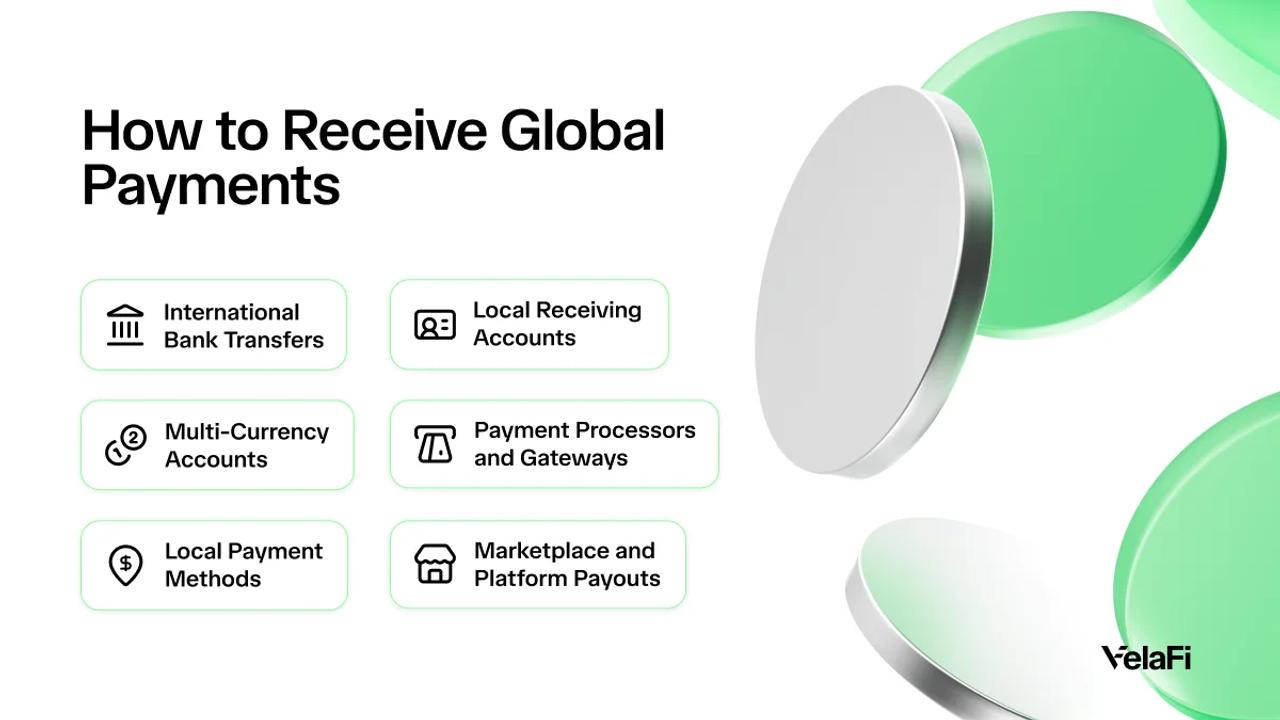
Here's how the six approaches compare:
| Method | What the Payer Does | What Distinguishes the Method |
|---|---|---|
| International bank transfer | Sends funds to an account in another country | May involve correspondent banks and intermediary charges |
| Local receiving account | Uses domestic account details for a local transfer | Gives the payer local receiving details connected to the business' collection arrangement |
| Multi-currency account | Sends funds using supported account details linked to a currency balance | Allows the business to manage balances in several supported currencies |
| Payment processor or gateway | Completes a payment through an online checkout | Manages checkout acceptance and related payment processing |
| Local payment method | Pays through a domestic rail or local option | Supports market-specific methods such as Pix, SPEI, or Bre-B |
| Marketplace or platform payout | Pays the platform during checkout | The platform subsequently distributes sales proceeds under its payout terms |
International Bank Transfers
International bank transfers move funds from the payer's bank to a business account in another country. They’re commonly used for invoices and other account-to-account B2B payments.
The sending and receiving banks don’t always exchange funds directly. A correspondent or intermediary institution may participate when the two banks lack the direct relationship needed for that payment route.
Required details depend on the countries and banking systems involved. They may include an account number, IBAN, BIC/SWIFT identifier, routing information, or payment reference.
International transfers work well for invoice-based B2B payments, but intermediary fees and processing times can affect the amount and timing of receipt.
Local Receiving Accounts
Local receiving accounts give customers account details they can use within their own market. Instead of initiating a conventional international transfer, the payer sends a domestic-style payment to the receiving business's details.
Local receiving details can be provided through different account arrangements:
- Virtual accounts: Identifiers assigned to a business or payment flow to receive funds and support payment reconciliation
- Local bank accounts: Accounts maintained through a banking relationship in the destination market, with ownership and access governed by the account arrangement
Businesses should confirm whose name the account is held in, which institution holds the funds, and how those funds are protected. These details can affect account access, fund safeguarding, and regulatory obligations.
Local receiving accounts are particularly useful for businesses collecting recurring payments from customers in the same market, as long as the arrangement supports their transaction types.
Multi-Currency Accounts
Multi-currency accounts allow businesses to hold and manage balances in several supported currencies.
However, holding a currency does not guarantee local receiving details or third-party collection capabilities. Check supported receiving and withdrawal options.
Payment Processors and Gateways
Processors and gateways let merchants accept checkout payments by supported cards, wallets, or local methods. Check fees, settlement currencies, and payout conditions.
Refunds, chargebacks, reserves, and payout schedules can change when merchants receive usable funds.
Local Payment Methods
Local payment methods use infrastructure already available within the payer's market. Depending on the country, these can include instant account-to-account transfers, other bank transfers, digital wallets, or voucher-based payment options.
Latin America offers several prominent examples:
- Pix: Brazil's instant payment system processes account-to-account payments around the clock, with funds generally available within seconds.
- SPEI: Banco de México's system processes electronic transfers between accounts at participating financial institutions in Mexico.
- Bre-B: Colombia's interoperable instant payment system connects participating institutions for immediate payments and transfers.
According to Banco Central do Brasil, 12.8 million businesses had made or received at least one Pix transaction by the end of 2025. Its widespread business use makes Pix relevant for companies collecting payments from Brazilian customers.
Marketplace and Platform Payouts
Marketplace and platform payouts allow businesses to receive sales proceeds collected by a third-party platform. The buyer pays through the marketplace, which later distributes eligible funds to the seller.
Marketplaces may determine payout schedules, supported settlement currencies, and conversion arrangements. Sellers should review the platform's payout terms, including any fees, reserves, or deductions that affect the amount and timing of receipt.
What Affects Global Payment Cost, Timing, and Settlement?
The payment route, currencies, institutions involved, and any additional conversion or review determine how much a business receives and when the funds become available.
Fees and Total Payment Cost
The fee quoted when a payment starts may represent only one part of the cost. Other charges can arise at different stages, so businesses should compare total payment costs rather than focus on a single transfer or processing fee.
Here are the typical cost components:
| Cost Component | How the Cost Can Arise |
|---|---|
| Transfer or processing fee | Charged when initiating, accepting, or processing a payment |
| Intermediary or receiving fee | Deducted or charged by institutions involved in the payment route |
| FX cost | Applied through a currency conversion fee, exchange-rate spread, or both |
| Account, payout, or withdrawal fee | Charged for maintaining certain accounts or transferring funds out |
| Refund or chargeback cost | May apply when a transaction is refunded, disputed, or charged back |
Payment and Settlement Timing
Banking hours, local holidays, and time zone differences can affect when incoming funds become available. Research published by the Committee on Payments and Market Infrastructures (CPMI) in 2025 identifies limited operating hours as a source of delays in cross-border settlement.
Before choosing a receiving method, businesses should check the provider's processing deadlines, expected settlement time, and any restrictions that apply outside normal banking hours.
Currency Conversion and Settlement
The payer's currency doesn’t always match the currency the business receives. Conversion may occur during collection or settlement, depending on the payment arrangement.
Businesses should confirm where conversion takes place, which exchange rate applies, and when the final amount becomes available. For recurring payments, clarify the settlement currency and conversion terms with the provider before the first transaction.
Compliance and Additional Review
Onboarding or individual payments may trigger verification based on jurisdiction, transaction type, and risk.
Common areas of review include:
- Business verification: During onboarding, providers may request legal entity information, ownership details, and other know-your-business (KYB) documentation.
- Payment information: Cross-border transfers can require information identifying the payer and beneficiary.
- Transaction context: A provider or bank may request an invoice, payment purpose, or supporting documents to verify the transaction.
- Risk controls: Sanctions screening, transaction monitoring, and jurisdiction-specific restrictions can affect how a payment is processed.
Additional checks can delay settlement, so keep invoices and supporting records available, especially for large or first-time payments.
How to Track and Reconcile Global Payments
Tracking shows a payment's current status and transaction details. Reliable reconciliation starts with consistent transaction data, including:
| Data to Capture | How It Supports Reconciliation |
|---|---|
| Payment or transaction reference | Links the payment to an invoice, order, customer, or internal record |
| Transaction status | Shows the current processing state and any required follow-up |
| Amount and currency | Shows whether the received payment matches the invoice amount or includes an unexplained shortfall |
| Fees and FX records | Supports separate recording of fees and currency-conversion entries |
| Settlement record | Shows the amount finally credited, including relevant settlement and conversion details |
| Exception information | Identifies payments that are unmatched, returned, or missing required data |
Missing payment references and combined payments covering several invoices make reconciliation harder. Unique transaction references or provider-supported virtual receiving accounts can make incoming payments easier to match with the correct customer or invoice.
How to Receive B2B Customer Payments Through VelaFi
VelaFi provides B2B payment infrastructure connecting local payment collections with cross-border settlement across supported markets. Businesses can use eligible receiving arrangements to collect funds through local payment methods and manage related currency conversion, international payouts, and transaction records.
1. Confirm the Collection Route and Complete Onboarding
Start by confirming the customer's country, payment currency, intended settlement destination, and eligibility for third-party collections with VelaFi.
Businesses must complete VelaFi's online business verification (KYB) process, which includes company registration information, ownership details, and supporting documents. Depending on the industry and jurisdiction, additional documents may be required.
2. Activate the Appropriate Receiving Arrangement
Once the relevant service is approved, the business can use the receiving arrangement available for its market and transaction type.
For example, VelaFi's supported Mexican payment infrastructure includes SPEI pay-ins and virtual-account options for eligible arrangements. Before sharing payment instructions, businesses should confirm whether their setup supports third-party corporate collections, which receiving details are assigned, and how the collected funds can be converted or settled internationally.
3. Share Payment Instructions and Collect Funds
For an eligible B2B invoice payment, the business shares the approved receiving details and required payment reference with its customer.
A Mexican business customer, for example, may be able to send an MXN payment through SPEI using the instructions provided for the supported collection.
The customer pays through the domestic payment method and does not need to interact with stablecoins.
4. Confirm Collection and Arrange International Settlement
After the customer sends the funds, the business checks the collection through the available platform or API records.
If the collection is part of an approved cross-border payment arrangement, VelaFi can support subsequent currency conversion and international payout according to the selected route and agreed terms.
Local payment confirmation does not necessarily mean the funds have reached the final overseas destination. Settlement availability and any additional processing requirements depend on the service configuration.
5. Track and Reconcile the Payment
For international transfers using VelaFi's Global Payment feature, businesses can track the Pay-in, Pay-out, and Funds Received stages and download completed order receipts. These stages describe the international transfer workflow and should not be assumed to represent every initial local collection.
VelaFi holds ISO 27001 certification and has completed an independent SOC 2 Type II audit covering its internal security controls.
Contact VelaFi to discuss the local collection and cross-border settlement options available for your customers, currencies, and markets.
FAQ
1. Do I need a foreign bank account to receive international business payments?
Not necessarily. Depending on the market and payment method, a business may receive funds through its existing bank account or provider-issued receiving details instead of opening an account in the payer's country.
2. Do I need a local company to receive payments from customers in another country?
You don't always need a local legal entity to receive payments from overseas customers. Opening a bank account directly in another market or conducting certain regulated activities may require local registration.
3. What happens after my customer sends an international payment?
The payment moves through the applicable banking or payment-processing stages before the receiving account or balance is credited. Depending on the route, currency conversion, compliance checks, and settlement schedules can affect when funds become available.
Check the provider's payment status and final settlement record rather than relying solely on the customer's payment confirmation.
4. Is my money protected if I use an international payment provider?
Protection depends on the provider, jurisdiction, and how it holds customer funds. Some regulatory regimes require payment providers to safeguard eligible customer funds, but safeguarding isn’t necessarily the same as bank-deposit insurance.
Editorial disclosure: This guide is published by VelaFi. The educational sections describe common industry models, while VelaFi-specific capabilities are based on the company's current product and regulatory information. Availability, regulated entities, payment rails, pricing, and processing times vary by product and corridor.
Sources:
- Fast Payments Are Driving Digital Transformation and Inclusion in Latin America and the Caribbean, World Bank, 2025
- Pix Consolida Liderança nos Pagamentos Digitais e Projeta Novas Evoluções Até 2030, Banco Central do Brasil, 2026
- Changing the Clock: Practical Approaches to Extend Payment System Operating Hours, CPMI/BIS, 2025